
There is a wall every short-term rental operator hits. It usually happens somewhere between 10 and 20 properties. You have built something that works. Your systems are running. Revenue is coming in. And then, almost overnight, everything starts to break.
Messages pile up faster than you can respond. Cleaners miss handoffs. Pricing changes in one channel do not sync to the others. You are the one holding everything together — and you are running out of hours in the day.
This is the 15-property wall. And how you respond to it will determine whether your portfolio grows to 50 properties or plateaus where it is.
The operators who break through it do not work harder. They build smarter infrastructure. Here is exactly what that looks like.
Why Scaling Beyond 15 Units Breaks Traditional Management
Managing 5 properties is a hustle. Managing 15 is a business. Managing 50 is an operation — and operations require systems, not effort.
Most operators try to scale by adding more of what already works: another spreadsheet, another app, another staff member. This creates what we call a fragmented stack — a collection of 6 to 10 disconnected tools that each do one thing and do not talk to each other.
A fragmented stack at 15 properties looks like this:
- A PMS that handles reservations but not guest communication
- A separate inbox tool that does not know room status or access codes
- A pricing tool that updates rates but does not sync in real time
- A cleaning app that is manually triggered after each checkout
- Guest notes scattered across texts, emails, and someone's memory
At 15 properties, a sharp operator can manage the gaps between these tools. At 30 properties, those gaps become expensive mistakes. At 50, they become the reason you stop growing.
The 5 Operational Systems You Need Before Scaling
Before adding your next property, audit these five systems. If any of them require manual intervention to function, you have found your bottleneck.
1. Centralized Guest Communication
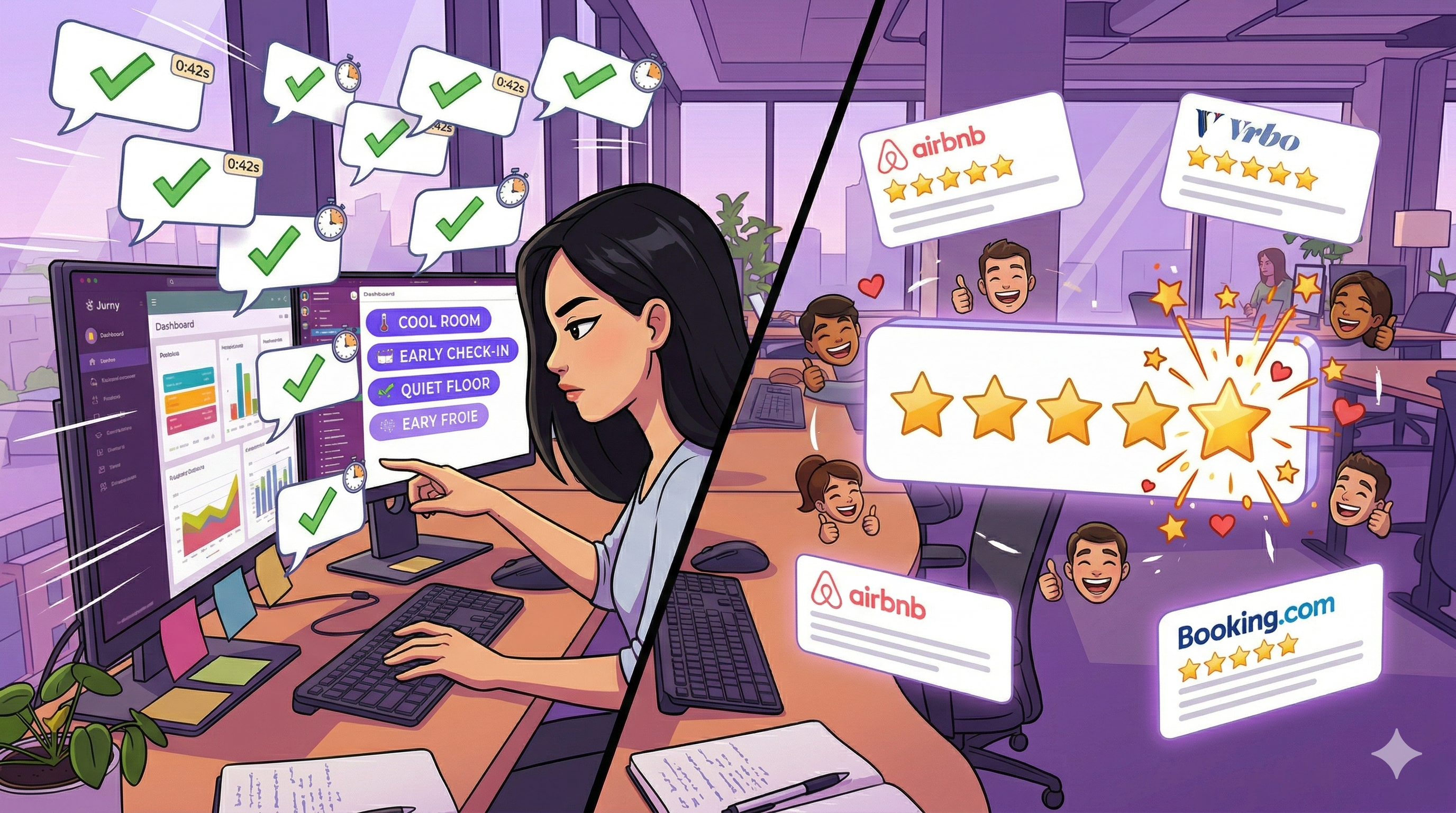
Every message across every channel — Airbnb, Vrbo, Booking.com, direct — should flow into one inbox, with automated responses handling 90%+ of inquiries. Not just templated auto-replies. Intelligent responses that know the property, the guest, the reservation, and the context.
If your team is still copy-pasting messages between tabs, you are not ready to scale. A unified AI inbox is not a luxury at 50 properties. It is the foundation.
2. Connected Pricing and Calendar Management
Rate changes should propagate to all channels instantly. Minimum stays, gap fills, and seasonal adjustments should update automatically based on demand signals. Manual pricing at scale is both time-consuming and inaccurate.
3. Automated Operations Handoffs
When a guest checks out, your cleaning team should be notified automatically. When cleaning is complete, your team should be notified automatically. When an issue is flagged, it should be escalated automatically. No human should be manually triggering these workflows.
4. Proactive Issue Detection
At 15 properties, you find out about problems from negative reviews. At 50 properties, that is too late and too expensive. You need sentiment analysis running on every guest interaction, flagging dissatisfaction before it becomes a public 2-star review.
5. Guest Data and History
Every returning guest should be recognized. Every preference should be remembered. Every upsell should be personalized based on who the guest is and why they are staying. This is not possible when your guest data is siloed in a PMS that does not share information with your messaging tool.
How AI Automation Changes the Math
The traditional math of scaling looks like this: add 10 properties, add 1 staff member. This model breaks down fast. Labor costs rise linearly with portfolio size, margins compress, and you end up owning a job rather than building a business.
The AI-native math is different. With the right infrastructure, your first 50 properties can operate with roughly the same team as your first 15 — because the AI is doing the work that would otherwise require additional headcount.
Inside Jurny, operators managing 50+ properties report that NIA, Jurny's network of AI agents, handles 95-99% of guest messages without human intervention. That is not a chatbot answering FAQs. That is an AI that knows room status, access codes, cleaning schedules, guest history, property policies, and OTA-specific rules — and uses all of that context to respond intelligently.
The result: a guest experience that feels personal at a scale that would be impossible with a human team.
Real Numbers: What Scaling from 15 to 50 Looks Like
Here is what the transition looks like in practice for operators who have made it:
- Response time: From 2-4 hours average to under 2 minutes, 24/7
- Message handling: From 3-4 hours per day to near zero for routine inquiries
- Upsell conversion: From 3-5% on generic offers to 25-40% on personalized, context-aware offers
- Review scores: Consistently above 4.8 because issues are caught before checkout, not after
- Team size: From 1 person per 10-15 properties to 1 person per 30-50 properties
The caveat: these numbers only hold when the infrastructure is centralized. Fragmented stacks do not scale. An AI-native platform built around a single source of truth does.
The One Question to Ask Before Your Next Acquisition
Before you sign on that next property, ask yourself one question: does my current stack centralize all my guest data, operational data, and communication in one place — and does my AI have access to all of it?
If the answer is no, adding more properties will not grow your business. It will stretch it.
The operators building 50-property portfolios in 2026 are not working more hours than you. They built the right foundation first.
If you are ready to build that foundation, book a demo with the Jurny team and see how operators like you are scaling without the chaos.
Explore Jurny: