
Every property management software company seems to be talking about AI right now. "Platform A" added AI messaging. "Platform B" has AI-assisted tools. A dozen new platforms have popped up claiming to be "AI-powered." So why does it feel like your operations are still just as manual as they were two years ago?
Because "AI-powered" and "AI-native" are not the same thing, and that distinction is costing property managers time, money, and a lot of unnecessary frustration.
If you've ever wondered why your PMS's "AI features" still require you to click through five menus, write your own templates, or manually trigger automations — this article explains exactly why that happens, and what to look for instead.
|
Quick Answer (TL;DR) An AI-native PMS is built from the ground up with artificial intelligence at its core — not a legacy system with AI features bolted on afterward. For property managers, this means the difference between a platform that learns, adapts, and acts automatically versus one that requires constant manual inputs to trigger anything useful. |
The Real Cost of "AI-Powered" vs. AI-Native: It's Not Obvious Until You're Inside the Platform
When a legacy PMS vendor adds an "AI feature," what they typically mean is: they've integrated a third-party AI tool — like OpenAI's API — into one corner of their platform. The result is usually an AI chatbot that can draft messages, or a pricing engine that can suggest rate changes. Useful, yes. But it's a layer on top of an old foundation — not a new structure.
The underlying platform still requires manual steps. You still configure workflows by hand. The AI doesn't know your full operational context — it only sees the slice of data it was connected to.
Property managers on AI-overlay stacks typically spend 2–3 hours per day on tasks that AI-native platforms reduce to under an hour. That’s time that compounds across every day of the year — and across every property in your portfolio.
For operators managing 15+ properties manually, the staff costs attributable to repetitive, automatable tasks often exceed the entire cost of a modern PMS. That gap — between what you’re paying for manual work and what automation actually costs — is where AI-native platforms generate their ROI.
What Makes a PMS Truly AI-Native? A Clear Definition
An AI-native PMS is a property management system where artificial intelligence is not an add-on feature — it is the operating logic of the platform itself. Every core function — guest communication, reservations, pricing, task management, upsells, reviews — is designed to be informed, automated, or enhanced by AI from the start.
The 5 Markers of a Truly AI-Native Property Management System
1. Proactive automation, not reactive triggers — The AI acts without waiting for you to initiate. It detects a late check-in pattern and adjusts messaging automatically. It identifies an upsell opportunity at the right moment in the guest journey, not because you set up a rule.
2. Unified data model — The AI has full visibility across your entire portfolio: reservations, guest profiles, revenue, reviews, and operations. Not just one department of data.
3. Learning over time — A native AI improves with your operational history. It gets better at predicting guest needs, pricing windows, and maintenance patterns the longer you use the platform.
4. No-code automation depth — Workflows aren't triggered by a human configuring rules; the AI configures itself based on context and outcomes.
5. Unified pricing by context — AI-native pricing doesn't just react to market rates; it factors in your specific property's booking pace, review trajectory, and guest segment simultaneously.
AI-Powered PMS: What It Actually Looks Like in Practice
To be fair, AI-powered platforms are genuinely useful for many operators — especially those just starting to automate. The problem arises when the marketing language suggests something the product doesn't deliver.
Common AI-powered PMS scenarios you've probably experienced:
- You can ask the AI to draft a guest response — but you still need to review, edit, and send it manually
- Dynamic pricing suggestions appear in the dashboard — but applying them requires manual confirmation for each property
- The "automation" feature lets you build rule-based sequences — but only fires when a specific trigger condition is met that you configured
- AI messaging works for the inbox — but doesn't connect to your ops calendar, so the AI doesn't know a maintenance issue is pending before it responds to a guest
None of these are bad features. They're just not native intelligence — they're smart shortcuts layered over a fundamentally manual workflow.
The Hidden Operational Cost of Piecemeal AI
When you add AI as an overlay on a legacy PMS, you typically end up with a multi-tool stack: one tool for messaging AI, another for dynamic pricing, your core PMS handling reservations and channels, and maybe a separate ops tool for housekeeping. Each tool has its own login, its own data silo, and its own billing cycle.
What this costs in practice:
- Time lost context-switching between tools — industry research puts this at 22 minutes of refocus time per switch- Data inconsistencies when tools don't sync in real time — guest data in your messaging tool is 30 minutes behind your channel manager
- Add-on pricing that balloons your tech spend — platforms with modular AI features typically cost 2–3x their base price once messaging, pricing, and ops add-ons are stacked
- Higher staff training burden — each new tool requires onboarding, support tickets, and ongoing troubleshooting
For an operator managing +15 properties, these aren't minor inconveniences. They represent hours per week of unrecoverable time.
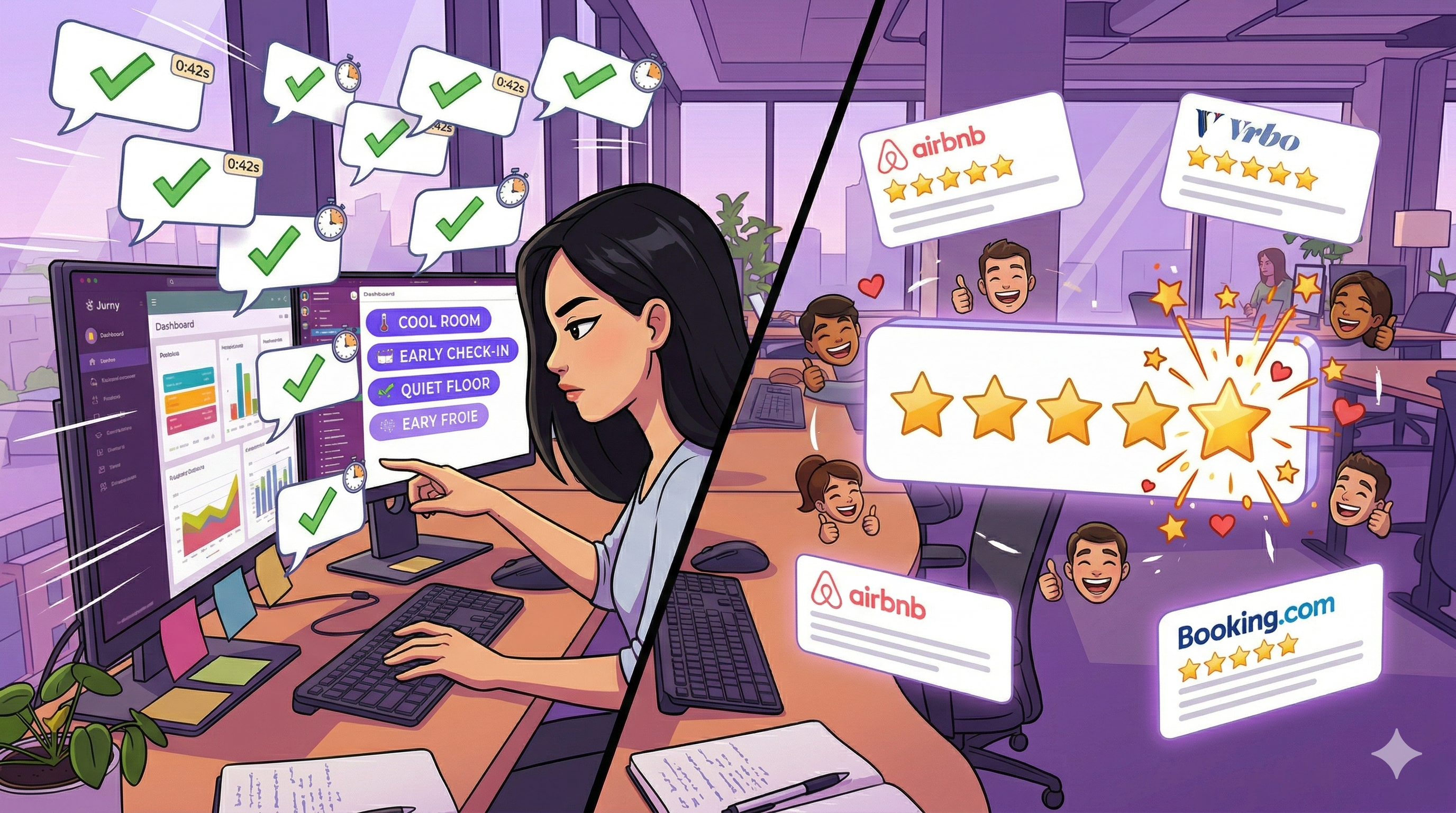
Before vs. After: The Operational Difference at 15 Units
Managing 15 properties with an AI-powered PMS (add-on model):
- Morning routine: Check 3 separate tools for overnight messages, pricing alerts, and ops flags — ~45 minutes- Guest messaging: AI drafts responses, you review and send each one — ~30 min/day
- Pricing: Review AI suggestions in pricing tool, apply manually in PMS — ~20 min/day
- Upsells: Manually identify and send upsell offers when you remember to — inconsistent, low conversion
- Reviews: Check separately, respond manually — ~20 min/day
Total active management time: ~2.5–3 hours/day
Managing 15 properties with an AI-native PMS:
- Morning routine: Single dashboard with AI-prioritized action items — ~10 minutes- Guest messaging: AI handles up to 85% of conversations autonomously; you approve or intervene on flagged items
- Pricing: Updated automatically across all 15 properties overnight
- Upsells: Triggered automatically at optimal points in every reservation journey
- Reviews: AI drafts responses for your approval in batches
Total active management time: ~45–60 minutes/day
How to Evaluate a PMS Vendor's AI Claims
Every vendor will tell you they're AI-driven. Here's how to cut through the marketing and evaluate the actual product:
1. Ask where the AI lives in the platform. Is it a standalone messaging module? Or does it inform pricing, ops, guest experience, and channel management simultaneously?
2. Ask what requires human confirmation. The more steps that require a human to approve before action is taken, the less native the AI actually is.
3. Ask about AI training data. Does the AI learn from your property-specific history? Or is it a general model applied to all customers equally?
4. Ask about integration count. A high integration count often signals a patched-together stack, not a unified platform.
5. Ask for a workflow demo without touching the settings. Can the AI handle a guest complaint end-to-end without a pre-configured template? That's the real test.
This Is Exactly the Problem Jurny Was Built to Solve
Jurny is built AI-native from the ground up. NIA — Jurny's AI — isn't a third-party integration or a messaging add-on. It's the operating intelligence of the entire platform, connecting guest communication, reservations, dynamic pricing, upsells, reviews, and channel management into one unified system.
Unlike AI-overlay platforms, NIA has full visibility across your portfolio — so it doesn't just answer a guest message; it answers the right message at the right time, with context about their reservation, your property status, and the optimal upsell moment baked in. The result is a platform where operators managing 20+ properties spend less than an hour a day on active management — not because they've hired better staff, but because the AI is genuinely doing the work.
Frequently Asked Questions
What is an AI-native PMS?
An AI-native PMS is a property management system where artificial intelligence is the core operating logic — not a feature layered on top. In a truly AI-native platform, every function including guest messaging, pricing, upsells, and operations is informed and automated by AI without requiring manual triggers or configuration by the operator.
Is AI-powered the same as AI-native?
No. AI-powered typically describes a platform that has added AI features — often via third-party integrations — to an existing software foundation. The underlying workflows may still be manual. AI-native means the platform was architecturally designed around AI from day one, with the intelligence embedded across all functions.
How much time can an AI-native PMS actually save?
Based on operator data, property managers using AI-native platforms typically reduce active daily management time by 60–75% compared to AI-overlay stacks. For a 15-property portfolio, that translates to roughly 1.5–2 hours saved per day — or over 500 hours annually.
Will AI-native PMS platforms replace property management staff?
Not replace — redeploy. The operators seeing the most benefit from AI-native platforms aren't laying off staff; they're reassigning them from reactive task execution to proactive growth work like owner acquisition, direct booking strategy, and property expansion. AI handles the repetitive; your team handles the high-value.



.png)