
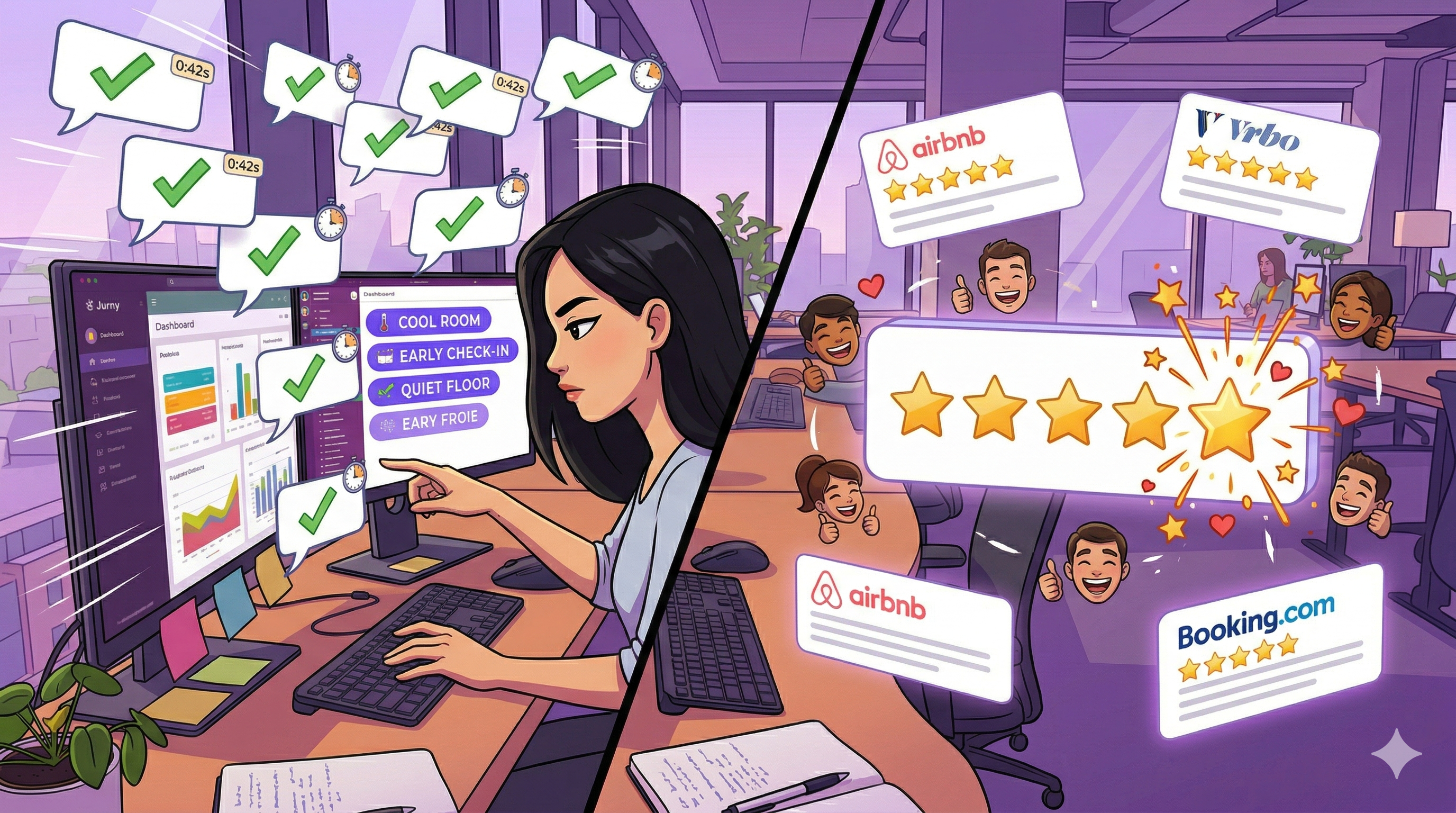
TL;DR: Automated guest messaging AI improves review scores through three mechanisms: faster response times (often sub-60-seconds, 24/7), more consistent and accurate mid-stay support, and systematic review response automation. Each of these independently improves reviews — together, they create a measurable, compounding improvement in OTA ranking and booking volume.
Every property manager knows review scores matter. What’s less understood is exactly how AI guest communication — not just better service, but the specific mechanism of AI messaging — improves those scores systematically.
This isn’t about being nicer to guests. It’s about the structural connection between communication performance and review outcomes — and how automated guest messaging AI optimizes each part of that chain.
The Review Score Chain
Review scores don’t come from nowhere. They’re shaped by specific moments in the guest experience:
- Pre-arrival: Did the host communicate clearly and proactively? Did I feel informed and prepared?
- Check-in: Was the process smooth? Were my questions answered quickly when I got stuck?
- During stay: When I had an issue or question, did the host respond quickly and helpfully?
- Post-stay reflection: Overall, did I feel well taken care of? Would I stay again and recommend this property?
Automated guest messaging AI directly improves experiences at every one of these moments. Not indirectly — mechanically, specifically, and measurably.
Mechanism 1: Pre-Arrival Communication Quality
The anxious pre-arrival period is when guests form their first real impression of how the stay is going to go. They’ve paid for the property. They’re anticipating the trip. And they often have questions or confirmations they want before they arrive.
Guests who receive:
- Confirmation messages shortly after booking
- Proactive pre-arrival communication with check-in details
- Fast, accurate answers to their pre-arrival questions
…arrive at the property with a positive foundation. They feel informed and prepared. Any minor friction on arrival (a small cleaning detail, a confusing parking situation) gets filtered through that positive prior experience and tends to not affect the review.
Guests who receive slow or incomplete pre-arrival communication arrive uncertain. Minor friction on arrival confirms their uncertainty and shows up in the review.
What AI does here: Automated guest messaging AI delivers confirmation and pre-arrival communications automatically, on schedule, with property-specific accuracy. Pre-arrival questions get answered in under 60 seconds, any time of day. The guest arrives informed and prepared — which sets the review floor higher before they’ve even walked in.
Mechanism 2: Check-In Experience and Instant Support
Check-in is the highest-anxiety moment of any stay. New place. Unfamiliar access system. Possibly arriving late, possibly with kids or elderly guests. When something doesn’t work immediately — the smart lock code is confusing, parking instructions were unclear, the WiFi isn’t connecting — the guest’s first instinct is to message the host.
What happens next shapes the review more than almost anything else:
- Response in under 2 minutes: Problem acknowledged, solution provided. Guest resolves the issue, settles in, feels supported.
- Response in 4+ hours: Guest is stuck, anxious, frustrated. They may have figured it out themselves, but the experience of feeling abandoned at the critical moment stays with them. The 4-star review reflects it.
What AI does here: Automated guest messaging AI responds to every check-in support message within 60 seconds, with accurate, property-specific solutions. The WiFi password is correct. The smart lock instructions are specific to that lock model. The parking directions are for that specific property’s garage.
Across hundreds of interactions, this mechanical improvement in response speed at check-in correlates directly with higher review scores in the “communication” and “check-in” categories.
Mechanism 3: Mid-Stay Issue Resolution Speed
Guests don’t expect properties to be perfect. They expect hosts to respond well when something isn’t perfect.
A mid-stay issue — the dishwasher isn’t draining, the hot tub is cold, the AC is making noise — resolved quickly and professionally almost never results in a negative review. The same issue, with a slow or unhelpful response, almost always does.
Speed matters more than guests consciously acknowledge. When an issue is resolved within an hour, the guest’s memory of the stay includes “there was a minor issue, but they took care of it immediately.” When resolution takes a day, the issue defines the stay in the guest’s review.
What AI does here: Automated guest messaging AI acknowledges every mid-stay message immediately, provides a solution if one exists autonomously, and escalates genuine maintenance issues to you with full context and urgency flag. Guests always know their message was received and is being addressed — which is often what they need to remain patient while the issue is resolved.
Mechanism 4: Proactive Mid-Stay Outreach
One of the highest-leverage things a vacation rental host can do to improve review scores is reach out mid-stay to check in on the guest. A simple “Hope you’re enjoying your stay! Please let us know if there’s anything we can do to make it better” message — sent proactively, before any issue arises — signals attentiveness and gives guests an easy opening to raise concerns before they become review-level grievances.
Most hosts know this is valuable. Almost none do it consistently because it requires remembering and taking action for every single active reservation.
What AI does here: Automated guest messaging AI schedules and sends mid-stay outreach automatically for every booking. Every guest gets a check-in message. Issues surface earlier, when they’re easier to resolve. Guests feel cared for. Review scores reflect it.
Mechanism 5: Review Response Automation
The review itself is the end product. But what happens after the review is posted also matters — both for ranking and for how future guests perceive your property.
Response rate affects OTA ranking. Platforms that track review engagement (Booking.com explicitly rewards it) rank hosts with higher review response rates more favorably. A 100% review response rate consistently ranks higher than a 50% response rate.
Response quality affects prospective bookings. When a guest reads your listing and sees a negative review, what they also see is your response. A professional, thoughtful response to a negative review — that acknowledges the feedback and explains what was done — converts skeptical lookers into bookings. An unanswered negative review converts them away.
What AI does here: Automated guest messaging AI responds to every review automatically — positive and negative — with personalized, brand-appropriate content. The AI references the specific review content (it doesn’t just append a template). Negative reviews get de-escalating, professional responses. Positive reviews get warm acknowledgment.
The mechanical outcome: 100% review response rate, consistent quality, no manual effort.
The Compounding Effect
Each of these mechanisms improves review scores. But the compounding effect is where the real value lies.
Better review scores → better OTA ranking → more visibility → more bookings → more reviews → better ranking.
Properties that run this loop with AI do it consistently, at scale, without the degradation in quality that happens when a manual operator gets busy. The compounding effect of AI-driven communication quality — operating at the same level for the 200th booking as for the 10th — is what separates the top-performing properties from the rest over time.
Industry data supports this: properties using AI guest communication tools report measurable improvement in review scores within 60–90 days of implementation, driven specifically by the response time and consistency improvements.
A Note on Tone: The “Robotic” Concern
The most common concern operators raise about AI messaging is that it will feel impersonal — that guests will notice they’re talking to a bot and that will negatively affect the experience and the review.
In practice, the opposite tends to be true. Guests don’t experience “AI” — they experience attentive, instant, accurate communication. The host who responds in 30 seconds with the right answer feels more attentive than the host who responds in 4 hours with the same answer.
Good automated guest messaging AI is calibrated to your tone and style. It reflects warmth when warmth is appropriate, efficiency when efficiency is what the guest needs. It doesn’t use stilted, robotic language. It sounds like a competent, attentive hospitality professional — which is what guests want.
How Jurny’s NIA Delivers Review Score Improvement
Jurny’s NIA communication agent addresses every mechanism described above:
- Sub-60-second response times, 24/7, across all channels
- Automatic pre-arrival and confirmation messaging, property-specific
- Mid-stay check-in messages for every active booking
- Immediate acknowledgment and escalation for maintenance issues
- Review response automation across all OTAs, every review
Properties managed on Jurny consistently see review score improvements within 60–90 days, driven by the mechanical communication quality that NIA delivers at scale.
Frequently Asked Questions
How quickly does automated guest messaging AI improve review scores? Most properties see measurable improvement within 60–90 days of implementing AI guest communication. The improvement comes from faster response times, better mid-stay support, and proactive outreach — all of which feed into the communication and overall experience categories of guest reviews.
Does responding to reviews actually affect bookings? Yes — in two ways. Review response rate is a direct ranking factor on platforms like Booking.com. And for prospective guests reading your listing, professional responses to negative reviews significantly influence booking decisions.
Can AI maintain a warm, personal tone while still being automated? Yes — when the AI is properly calibrated to your communication style. Good AI messaging systems are configured with tone and personality preferences at setup. The result is communication that reflects your brand voice, not generic AI output.
What’s the most impactful improvement AI makes to review scores? Response time at critical moments — check-in support and mid-stay issue resolution — has the highest per-message impact on review scores. Being available in under 60 seconds when a guest is stuck at 11pm is the single most powerful thing AI does for review outcomes.
Does automated review response help with new listings trying to build a reputation? Especially so. New listings benefit from 100% review response rates as a signal of active host engagement. AI makes this achievable from the first review, without the manual overhead that might otherwise cause new hosts to skip responses when busy.
Ready to build better review scores systematically? See how Jurny’s automated guest messaging AI delivers consistent communication quality for property managers like you. Book a Demo Today!
Explore Jurny: