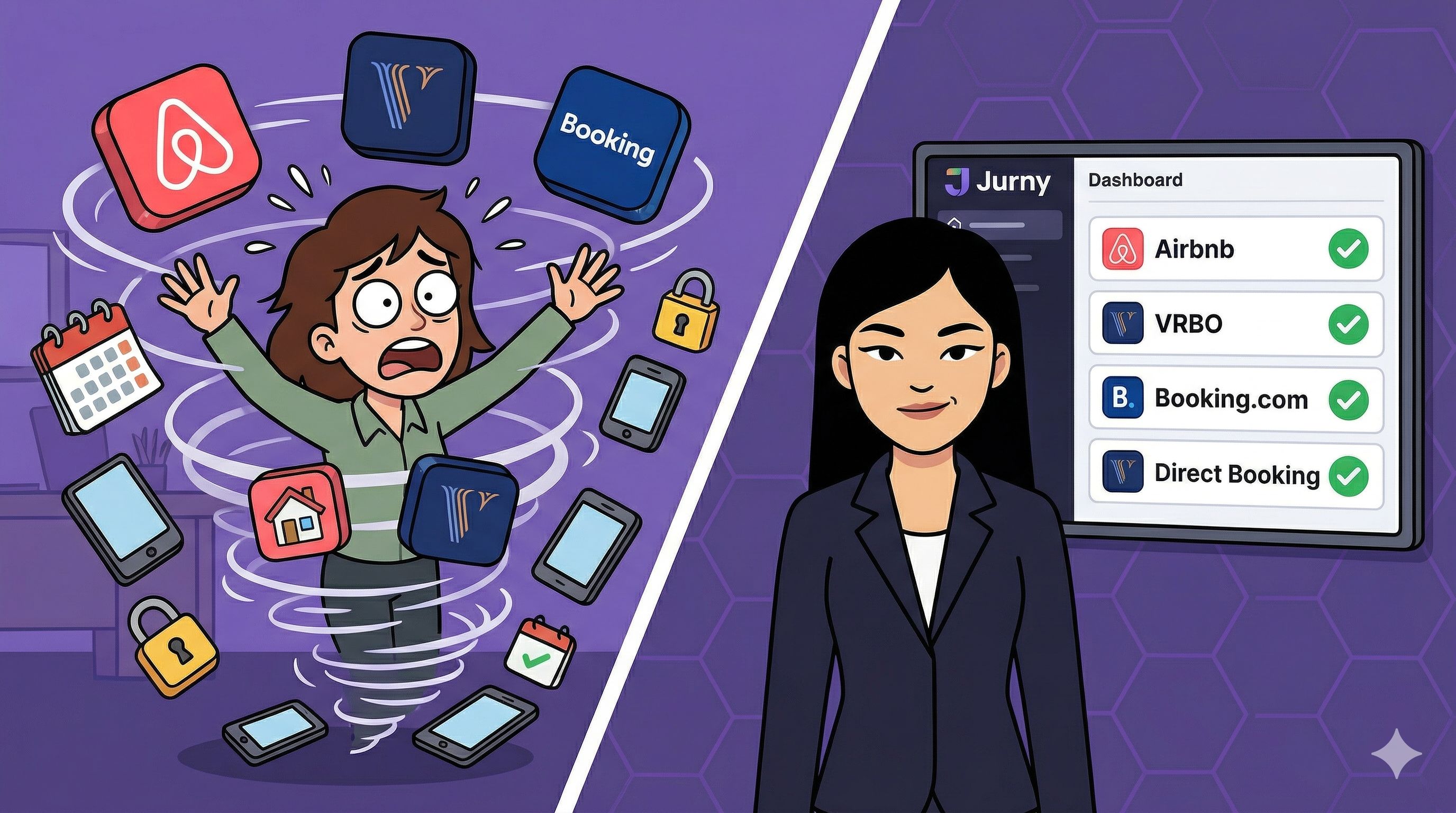
You picked a property management system because it checked all the boxes — at the time. It handled your reservations, synced your calendars, and kept things running. But somewhere between unit 12 and unit 30, something shifted. The system that worked for five listings started slowing you down at fifty. Workflows that once felt smooth became rigid. Features you needed weren't there. And workarounds multiplied.
If this sounds familiar, you're not alone. Most property managers don't outgrow their ambition — they outgrow their software.
The inconvenient truth about most property management platforms is that they're built for the average operator, not for how you actually run your business. And when your business grows, scales into new markets, or develops its own operational rhythms, a one-size-fits-all system becomes a ceiling instead of a foundation.
|
TL;DR: A highly customizable property management system lets STR operators build workflows, automations, and integrations that match how they actually operate — instead of forcing their business to conform to rigid software. It's the difference between a tool that serves your growth and one that limits it. |
The Problem with Standard Property Management Software
Standard PMS platforms are designed around a median use case. They assume you check in guests the same way every property manager does, price your listings the same way, communicate with guests on the same schedule, and report to owners using the same template.
But short-term rental operations are anything but uniform. A manager running 15 luxury beachfront villas has completely different workflows than one managing 80 urban studio apartments. A host who prioritizes direct bookings needs different automation than one who lives and dies by Airbnb.
According to industry data, the percentage of property management companies using AI and automation tools jumped from 20% to 58% in a single year — which means the bar for operational sophistication is rising fast. If your software can't keep up with how the industry is evolving, your competitors' software will.
What Rigidity Actually Costs You
When your PMS can't flex to your needs, you compensate. You use more tools. You build manual steps into your team's daily routines. You create workarounds that depend on specific people remembering to do specific things. Every one of these workarounds is a liability — a place where things break, guests suffer, and reviews take a hit.
The operational cost of inflexibility is real: more staff time on repetitive tasks, higher error rates on bookings and communications, and slower response times to guests. In a review-driven industry where 82% of travelers read reviews before booking, a single missed message or miscommunication can ripple into a 3-star review that costs you dozens of future reservations.
What 'Highly Customizable' Actually Means in a PMS
Customization gets used loosely in software marketing. Let's be specific about what it actually means when it matters for property managers.
Here's the expanded, more generic version of that section:
What 'Highly Customizable' Actually Means in a PMS
Customization gets used loosely in software marketing. Here's what it actually means when it matters for property managers.
Automation That Matches Your Logic
A flexible PMS lets you define the rules — not the other way around. What triggers a cleaning request? When does a maintenance alert escalate? What happens when a guest hasn't checked in by a certain time? Your operation has its own answers to these questions. Your software should too.
Guest Communication Built Around Your Brand
Cookie-cutter messaging sounds like every other host. A customizable platform lets you set tone, timing, and content by property type, booking source, stay length, or guest profile — so every touchpoint feels intentional, not automated.
Integration Flexibility You Actually Control
Your PMS should plug into the tools you already trust — pricing engines, cleaning platforms, smart locks, owner portals. The key word is control: you decide what connects, when data flows, and how systems talk to each other. A closed ecosystem that limits integrations is a vendor lock-in strategy, not a feature.
Role and Permission Management
As your team grows, so does the need for access control. A customizable PMS lets you define who sees what — from maintenance staff to owner-facing reports — without giving everyone access to everything or building workarounds around a rigid permission structure.
Property and Owner-Level Configuration
No two owners are the same. Neither are your properties. Customizable software lets you configure payout structures, reporting preferences, and communication rules at the individual level — not just globally across your whole account.
Modular Feature Adoption
You shouldn't have to buy a fully loaded system on day one. The best platforms let you start with what you need and layer in capabilities — revenue management, AI-powered upsells, advanced analytics — as your portfolio grows and justifies it.
Reporting That Answers Your Questions
Default dashboards are built for the average manager. If you're managing a mix of property types, owner structures, or markets, you need reporting that reflects your specific portfolio — not a one-size-fits-all summary that leaves you exporting to spreadsheets anyway.
How to Evaluate PMS Flexibility Before You Commit
Before signing up for any platform, ask these specific questions:
- Can I build custom automation triggers based on my own conditions?
- Does the platform offer an open API with documented endpoints?
- Can I configure messaging and workflows at the property or property-type level?
- Is pricing modular, or am I forced into an all-or-nothing tier?
- How does the platform handle custom owner reporting?
- What does onboarding look like for a portfolio my size?
If a vendor can't answer these questions clearly, that's your answer.
Why Customization Becomes a Competitive Moat
Here's the strategic angle most property managers don't think about: a highly customizable property management system isn't just an operational tool — it's a competitive differentiator.
When your workflows are tighter, your guest communication is faster, your pricing is more intelligent, and your team spends less time on repetitive tasks, the downstream effect is better reviews, higher occupancy, and stronger owner relationships. None of those outcomes are available to a competitor running the same rigid, out-of-the-box PMS that everyone else is using.
The operators scaling fastest right now — from 20 units to 200, from one city to five — are doing it on platforms that adapt to their growth instead of constraining it. Customization isn't a luxury feature. For serious operators, it's a prerequisite.
How Jurny Approaches Customization
Jurny is built as an AI-native property management platform designed specifically for STR operators who need flexibility without complexity. Rather than forcing operators into fixed workflows, Jurny's platform — powered by its AI engine NIA — adapts to how each property and portfolio actually operates.
NIA handles guest communication, automates upsells, responds to reviews, and coordinates workflows across your portfolio — with configuration options that reflect the realities of managing different property types, guest profiles, and owner expectations. Jurny also integrates with leading tools for dynamic pricing, smart devices, and channel management, giving operators the open ecosystem they need to build the tech stack that fits their business.
Frequently Asked Questions
|
What makes a property management system 'highly customizable'? A highly customizable PMS lets you define your own automation triggers, configure messaging at the property level, connect to external tools via an open API, and adopt features modularly as your business grows. The key signal is whether the software adapts to your workflows — or whether you're forced to adapt to its defaults. |
|
How do I know if my current PMS is limiting my growth? Signs your PMS is holding you back: you're maintaining manual workarounds to handle things the system can't do, your team is compensating with extra steps, you can't configure different workflows for different property types, or you're paying for integrations the platform should handle natively. |
|
Will a highly customizable PMS cost more than a standard one? Not necessarily. Many flexible platforms, including AI-native options, offer modular pricing that scales with your portfolio. The real cost comparison should factor in what you're spending on manual workarounds, additional tools, and the operational inefficiency of a rigid system — costs that rarely show up in a simple price comparison. |
|
What's the difference between customization and just having more integrations? Integrations connect tools together, but the logic is still predetermined. True customization means you control the decision rules, the timing, and the conditions — not just which tools are plugged in. |
|
How will AI change PMS customization going forward? AI will make configuration dramatically more accessible. Instead of navigating complex settings, operators will describe what they need in plain language and the platform will build and adjust it automatically. The operators building flexible systems now will have a significant head start. |
See how Jurny adapts to your operation. Book a free demo.
Explore Jurny: