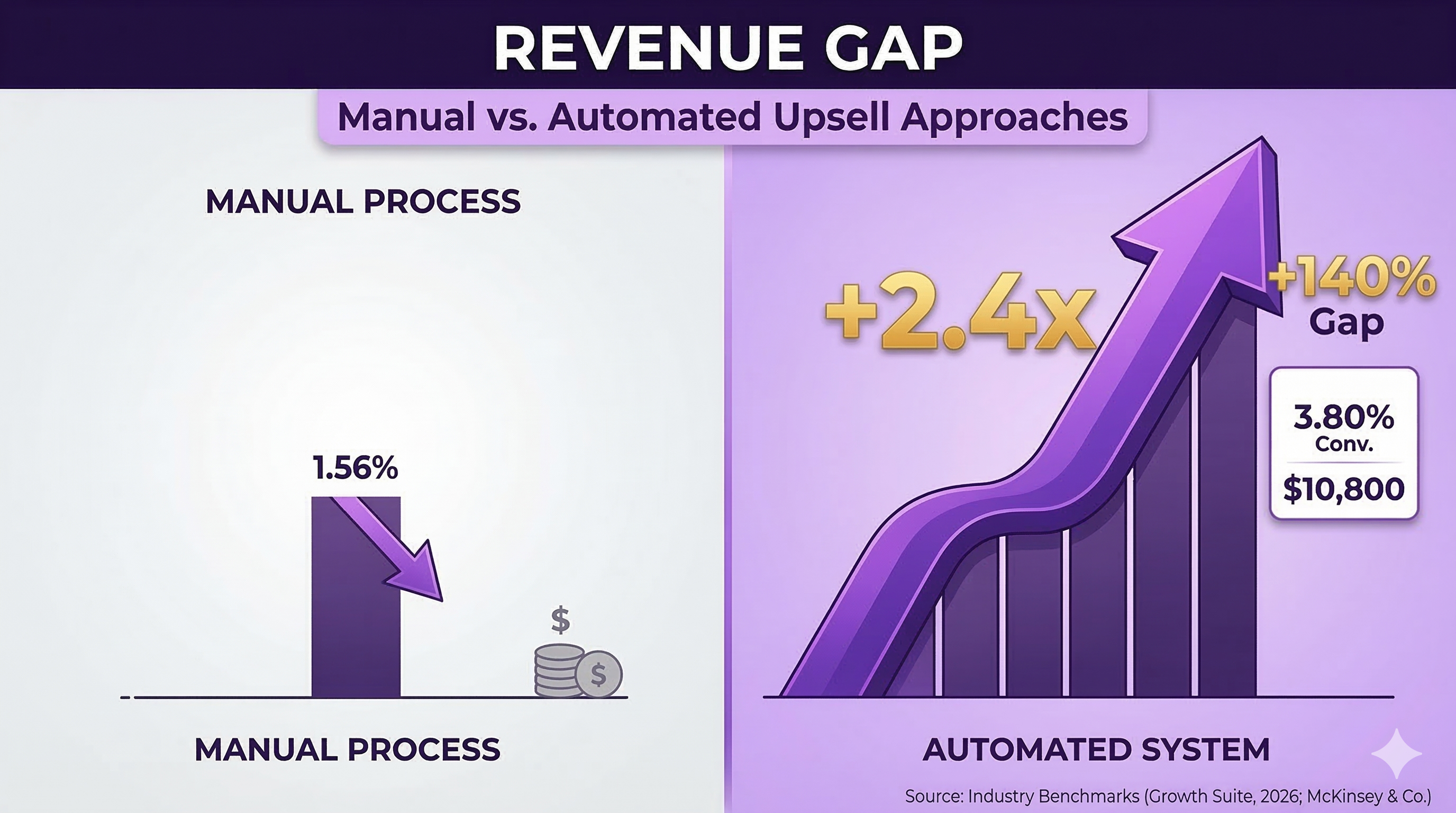
Most short-term rental operators know they should be doing upsells. Some are even doing them — sending a manual offer for early check-in here, a mid-stay restock suggestion there. But very few know whether what they're generating is good, average, or leaving serious money uncaptured.
That's because almost no one publishes upsell benchmarks for the STR industry. Hotel chains track upsell attach rates obsessively. Airlines publish ancillary revenue per passenger as a KPI. But in the vacation rental space, operators are mostly guessing — offering upsells inconsistently, with no visibility into what their portfolio should realistically be generating.
This guide changes that. Based on data from Jurny's portfolio and aggregated STR industry research, here are the 2026 upsell revenue benchmarks for vacation rental operators — broken down by property type, upsell category, and automation level.
|
Quick Answer (TL;DR) STR upsell revenue benchmarks for 2026 show that operators using automated upsell systems generate $28–$55 per reservation in ancillary revenue, compared to $8–$14 for those relying on manual offers. The gap is driven almost entirely by timing, consistency, and offer relevance — all of which automation solves directly. |
Why Most Operators Are Underperforming on Upsells
Before the benchmarks, it's worth understanding why the gap between "what you could earn" and "what you actually earn" from upsells is so large for most operators.
The three root causes:
1. Inconsistency — Manual upsell offers are sent when the operator remembers. That means busy weeks see zero upsell touchpoints, and conversions are entirely dependent on whether the offer happened at all.
2. Wrong timing — The research on upsell conversion consistently shows that timing matters more than offer quality. An early check-in offer sent at booking confirmation converts at 3–4x the rate of the same offer sent the day before arrival. Most manual operators miss the optimal window.
3. Generic offers — "Would you like early check-in?" sent to every guest regardless of their booking length, arrival time, or property type performs far worse than a contextually relevant offer. AI-driven upsells that factor in reservation specifics see 2–3x higher acceptance rates.
The financial cost of inconsistency: For a portfolio of 15 properties averaging 18 reservations/year each (270 reservations annually), the difference between $8 average upsell revenue per reservation and $45 is $2,160 vs. $12,150 — a gap of nearly $10,000 per year. Spread across a portfolio, this compounds quickly.
2026 STR Upsell Revenue Benchmarks
Overall Benchmarks by Automation Level
|
Upsell Approach |
Avg Revenue per Reservation |
Annual Revenue (15-unit portfolio) |
|
No upsells |
$0 |
$0 |
|
Manual, occasional offers |
$8–$14 |
$2,160–$3,780 |
|
Structured manual (templates, consistent send) |
$15–$22 |
$4,050–$5,940 |
|
Automated (rule-based triggers) |
$22–$35 |
$5,940–$9,450 |
|
AI-native automated (context-aware, optimally timed) |
$38–$55 |
$10,260–$14,850 |
Benchmark by Upsell Category
|
Upsell Type |
Avg Conversion Rate |
Avg Revenue per Accepted Offer |
|
Early check-in |
18–28% |
$35–$75 |
|
Late checkout |
14–22% |
$35–$75 |
|
Mid-stay restocking (essentials) |
8–14% |
$20–$45 |
|
Local experience / activity packages |
5–12% |
$40–$120 |
|
Pet fee (where permitted) |
22–35% of pet bookings |
$50–$150 |
|
Pool/hot tub heating |
15–30% of applicable properties |
$30–$80 |
|
Grocery/welcome package pre-stock |
10–18% |
$35–$85 |
|
Extra cleaning mid-stay |
6–10% |
$60–$120 |
Benchmark by Property Type
|
Property Type |
Avg Monthly Upsell Revenue |
Top Performing Category |
|
Urban apartment (1–2BR) |
$35–$65 |
Early/late checkout |
|
Beach house (3–5BR) |
$85–$160 |
Experience packages, grocery pre-stock |
|
Mountain/ski cabin |
$90–$175 |
Experience packages, firewood, hot tub |
|
Luxury villa (5BR+) |
$150–$400 |
Concierge packages, car rentals, private chef |
|
Rural/nature retreat |
$55–$110 |
Activity packages, firewood, bike/gear rentals |
The Timing Factor: When to Send Each Offer
Timing is the single largest driver of upsell conversion rates. Here's the data on optimal send timing by upsell type:
- Early check-in offer: Send at booking confirmation (not 24 hours before arrival). Conversion rate is 22–28% at booking confirmation vs. 8–12% the day before.
- Late checkout offer: Send 48 hours before arrival (when the guest is excited and planning). Conversion rate: 18–24%. If only sent day-of checkout: 6–10%.
- Mid-stay restocking: Send on Day 2 or Day 3 of stay (when guests know what they've run out of). Conversion: 10–16%.
- Experience packages: Send 5–7 days before arrival (when guests are actively planning the trip). Conversion: 8–14%. Same offer sent day-of: 2–4%.
- Welcome grocery package: Send 2–3 weeks before arrival (when guests are excited and haven't started packing). Conversion: 12–20%.
What Separates Top-Performing Portfolios from Average
When you look at the operators consistently generating $45+ per reservation in upsell revenue, a few patterns emerge:
1. They offer everything relevant, every time. Top performers don't cherry-pick which guests get upsell offers. Every reservation gets every applicable offer, sent at the right time. The consistency alone doubles performance vs. selective manual approaches.
2. Offers are property-specific. A mountain cabin gets the firewood bundle offer. A beach house gets the surfboard rental. Generic offers convert at a fraction of the rate of property-specific ones.
3. They track conversion rates by upsell type. Operators who review their upsell data monthly identify which offers underperform and adjust messaging or pricing accordingly.
4. They bundle small upsells. A "Welcome Package" ($35) that includes early check-in + a welcome bottle of wine converts better than each offered separately — and generates more per reservation.
How to Close the Upsell Revenue Gap on Your Portfolio
If your current upsell revenue per reservation is below $20, the path to improvement follows a clear sequence:
1. Audit your current upsell offers — Do you have early/late check-in, grocery pre-stock, and at least one experience offer for each property? If not, start there.
2. Fix your timing first — Even manual upsells, sent at the right time, will significantly outperform perfectly written offers sent at the wrong moment.
3. Create property-specific offer sets — One size doesn't fit all. Spend 30 minutes building a relevant upsell menu for each property type in your portfolio.
4. Automate — The jump from $15–22 to $38–55 per reservation happens when you automate timing and consistency. Manual systems, no matter how well-designed, cannot maintain the send discipline at scale.
This Is Exactly the Problem Jurny Was Built to Solve
Jurny's upsell module automates the entire sequence: offer creation, timing, delivery, and acceptance processing — across every reservation, every channel, every property. NIA identifies the optimal moment for each offer type based on reservation context and guest behavior patterns, not a generic schedule.
Frequently Asked Questions
What's a realistic upsell revenue target for a 10-property STR portfolio?
For a 10-property portfolio averaging 20 reservations per unit per year (200 reservations annually), a realistic target with automated upsells is $7,600–$11,000/year in additional revenue. The range depends on property types and markets — luxury and resort properties skew higher; urban studios skew lower.
Which upsell generates the highest ROI for most operators?
Early check-in and late checkout consistently deliver the highest ROI because they have near-zero marginal cost to offer and relatively high conversion rates (18–28%). The per-offer revenue is moderate ($35–$75), but the combination of high volume and zero cost makes them the most efficient upsell for any portfolio.
Should I price upsells higher or lower to maximize revenue?
Testing is the only reliable answer, but the general principle is: price upsells at perceived value, not cost. An early check-in that costs you nothing to offer should be priced at $35–$65 because that's what guests assign value to — not lower just because there's no cost. Underpricing your upsells is one of the most common mistakes in STR upsell strategy.
How do I know if my upsell conversion rates are above or below average?
Use these benchmarks as a baseline: 15–25% conversion on early/late check-in offers is average. Above 25% is strong. Below 12% suggests a timing or pricing problem. For experience packages, 6–12% is average; anything below 4% suggests the offers aren't relevant to your typical guest profile.
Do guests find automated upsell offers annoying?
When done poorly (too frequent, poorly timed, irrelevant), yes. When done well (contextually relevant, optimally timed, non-pushy tone), guest satisfaction research consistently shows neutral-to-positive reactions — and the subset of guests who engage have measurably higher satisfaction scores, likely because the upsells enhanced their stay.
See how Jurny's automated upsell engine helps property managers capture more revenue from every reservation. Book a free demo →
Explore Jurny: