
Quick Answer: AI in hospitality is genuinely transforming guest communication, dynamic pricing, and operational automation. But not every claim lives up to the label. In 2026, it's worth knowing exactly what works, what's overstated, and what's still on the horizon.
It's hard to read a hospitality industry newsletter right now without encountering AI claims. AI-powered check-in. AI-driven revenue management. AI that understands guests better than any human ever could.
Some of this is real. Some of it is marketing language stretched well past its breaking point.
If you're a property manager or STR operator trying to make actual decisions — about software, about staffing, about where to invest — you need a clear-eyed view of what AI can and cannot do in hospitality right now. That's what this is.
What AI in Hospitality Is Actually Doing Well Today
Guest Communication Automation — Real and Mature
This is the most proven AI application in hospitality. Large language models can read a guest's message, understand what they're asking (even when it's ambiguous), pull the relevant property information, and draft a contextually appropriate, personalized response — in seconds, in any language.
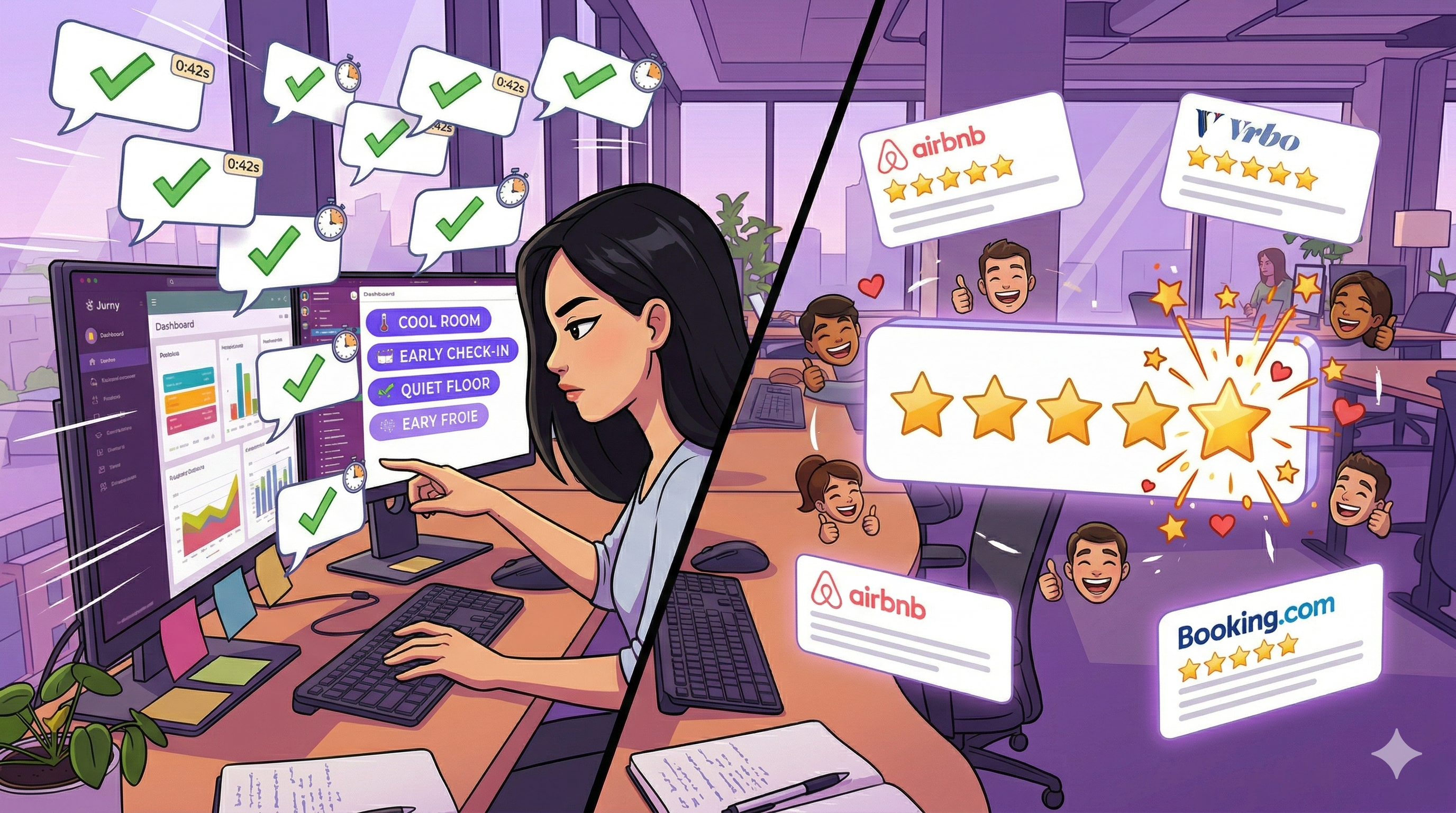
This isn't a future capability. It's working at scale right now. STR operators using AI communication tools are handling 70–90% of guest inquiries without any human involvement. The remaining fraction — complex disputes, unusual requests, genuine emergencies — gets flagged and routed appropriately.
The operational impact is significant: fewer hours on message management, faster response times, better review scores from guests who get immediate answers at 1am.
Dynamic Pricing Intelligence — Real and Effective
AI-powered pricing tools are genuinely effective and have been for several years. These systems analyze hundreds of variables simultaneously — local occupancy rates, competitor pricing, event calendars, booking velocity, historical patterns — and adjust nightly rates in real time.
Manual pricing, or static seasonal pricing, consistently underperforms. Operators using AI pricing typically see improvement in both occupancy and ADR because the system captures demand spikes that humans miss and fills gaps with strategic discounts.
Operational Workflow Automation — Real and Expanding
AI systems that coordinate cleaning schedules, maintenance requests, and turnover workflows are well past proof-of-concept. When a checkout is confirmed, an AI platform can trigger cleaning assignment, generate the next guest's access code, queue a pre-arrival message, and flag any maintenance notes from the previous stay — all automatically.
This is the unglamorous side of AI that operators often undervalue until they've used it. The coordination overhead of managing multiple properties grows exponentially without automation. AI handles the sequencing so you don't have to.
Predictive Insights and Anomaly Detection — Real and Growing
Modern AI platforms can flag when a property's review scores are trending down before you notice, identify which listing descriptions are underperforming, or surface the fact that a specific property's response time has slipped. These aren't predictions of the future — they're pattern recognition applied to your existing data, surfaced in real time.
What AI in Hospitality Is Overstated Right Now
'AI Understands Guests Better Than Humans' — Overstated
AI language models are very good at processing and responding to text. They're not good at the emotional intuition, relationship memory, and contextual judgment that experienced hospitality professionals develop over years. An AI can detect that a guest is frustrated; it can't always choose the right human response for a deeply upset long-stay guest who's had a string of problems.
The best framing: AI extends human capacity. It doesn't replicate human instinct.
'AI Will Run Your Properties Entirely Without You' — Premature
Full autonomy — where a property management platform operates without any human oversight — isn't here yet, and it's not advisable even where pieces of it are technically possible. The strongest operators use AI for everything it handles reliably, and stay in the loop for the situations that require judgment, creativity, or physical presence.
'AI Replaces the Need for Local Knowledge' — Overstated
AI systems are trained on data. They're not embedded in a community. Knowing which local contractor is reliable, how the seasonal rental market in your specific city actually works, how to handle a nuanced dispute with a neighbor — these still require human experience. AI makes you more efficient. It doesn't make you omniscient.
What's Still on the Horizon (but not quite there yet)
Some capabilities are legitimately advancing but aren't fully reliable at scale:
- Fully autonomous revenue strategy — AI setting and adjusting not just rates, but comprehensive revenue strategy across channels, without human review
- Real-time maintenance prediction from IoT sensor data — the infrastructure exists but integration is still maturing
- AI-driven owner relationship management — generating owner reports, flagging conversations, managing expectations autonomously
These are areas where the technology is advancing quickly. In 12–18 months, some of these will shift from "emerging" to "production-ready."
What the Numbers Show About What's Actually Working
The adoption data reflects where value is real. Buildium's 2026 Property Management Industry Report found that AI usage among property management companies tripled in a single year — from 20% to 58%. The areas driving that adoption are communication automation and operational efficiency, not speculative future capabilities.
HotelTechReport's 2026 PMS study found that 89% of operators using modern AI-powered platforms save between 2 and 10 hours per week on operational tasks. That's not an aspirational stat — it's what current, working technology delivers.
Meanwhile, 77% of multifamily operators using AI reported moderate to significant reductions in operating expenses, according to EliseAI's State of AI in Multifamily report. The ROI is materializing in real portfolios, not just pitch decks.
How to Evaluate AI Claims from Vendors
When a software platform tells you it uses AI, ask these five questions:
- What specific tasks does the AI handle without human input?
- What happens when it encounters a message or situation it hasn't seen before?
- Can you show me a live demo, not a pre-recorded one?
- What percentage of my guest inquiries will it resolve without escalation?
- What's the average time to first response once AI is deployed?
Vendors with real AI can answer these specifically. Vendors with marketing AI cannot.
Where Jurny Fits in the Landscape
Jurny focuses on the AI applications that are working right now — guest communication, reporting, and upsell optimization — through NIA, the AI engine at the center of the platform. The focus is on reliable, production-ready AI that delivers measurable results, not capabilities that exist on a roadmap but not yet in your dashboard.
The goal isn't to overpromise. It's to run your properties better starting from day one.
Frequently Asked Questions
Is AI in hospitality mature enough to rely on for daily operations?
For specific applications — guest messaging, dynamic pricing, operational workflow automation — yes. These capabilities are well-tested at scale and deliver consistent results. For more complex judgment calls or full autonomy, human oversight remains important.
What is the biggest real benefit of AI for STR operators today?
Time recovery. The biggest immediate impact operators report is getting back hours previously spent on guest communication and operational coordination. That time goes back into portfolio growth, owner relationships, and the work that genuinely requires a person.
How does AI handle guest communication in multiple languages?
Modern AI language models are trained on multilingual data and can understand and respond in dozens of languages naturally. For STR operators with international guests, this eliminates a significant communication gap without requiring multilingual staff.
Can AI fully automate my vacation rental business?
Not entirely — and it's better that way. AI handles the operational and communication layer autonomously. Humans stay in charge of judgment calls, physical operations, owner strategy, and anything that requires local knowledge or emotional intelligence. The combination is more powerful than either alone.
What should I watch out for when vendors claim their PMS uses AI?
Watch for vague language: 'AI-enhanced,' 'AI-powered insights,' 'smart automation.' These often mean rule-based templates or basic keyword matching. Ask for a live demo with edge-case scenarios. Real AI performs well on situations it hasn't been specifically trained for.
See What Working AI Looks Like in Short-Term Rental Management
Jurny gives you a live look at NIA handling real guest scenarios — not a slide deck. Book a demo today! →
Explore Jurny: