|
TL;DR OTAs like Airbnb and Booking.com give you reach — but they charge 15–20% per booking for it. Direct bookings cost you nothing in commission, but require upfront investment in brand and distribution. The smart play is a mix: use OTAs for discovery and fill, build direct for margin and loyalty. |
You got into short-term rentals to build something — not to hand 18% of every booking to a platform you don't control.
But here's the tension every property manager eventually hits: the OTAs work. Airbnb and Booking.com send guests to your door without you lifting a finger. Pull back too hard, and occupancy tanks. Lean in too much, and your margins quietly bleed out.
So what does the right balance actually look like? And how do you get there without torching your revenue in the process?
The Real Cost of OTA Dependence
OTA commissions typically run between 15–20% of gross booking revenue. On a $200/night booking, that's $30–$40 gone before you've paid a single operating cost.
Scale that across a portfolio of 20 units at 70% occupancy and you're handing over somewhere between $75,000 and $100,000 per year — just in OTA fees.
But commissions aren't the only problem. OTA reliance creates three structural risks most operators don't think about until they're stinging:
-
Algorithm exposure. Airbnb and Booking.com control your visibility. A policy change, a ranking update, or a bad review can cut your impressions overnight with zero warning.
-
No guest relationship. You don't own the email. You don't own the communication channel. Repeat guests book you again through the OTA �� and you pay the commission again.
-
No differentiation. On an OTA search results page, your listing competes on price, photos, and reviews. Brand, story, and experience don't surface until after the click.
According to industry research, properties with a strong direct booking channel generate 20–30% more revenue per available unit than comparable OTA-dependent properties — because every direct booking is a full-margin booking.
What Direct Bookings Actually Mean (And What They Don't)
"Direct bookings" doesn't mean abandoning OTAs. It means building a parallel channel — your own website, your own booking engine, your own guest relationship — so that not every transaction has to flow through a third party.
The goal isn't 100% direct. The goal is a healthy mix where:
- OTAs handle your top-of-funnel — discovery, new markets, fill nights you couldn't sell otherwise.
- Your direct channel handles repeat guests, longer stays, and high-value bookings where the margin matters most.
Most professional operators target somewhere between 30–50% direct bookings as a healthy ratio. At that level, you're still benefiting from OTA reach while meaningfully protecting your margin.
5 Strategies for Shifting the Balance Without Losing Occupancy
1. Build a direct booking website that actually converts
Your direct booking site competes with Airbnb's UX. That's a high bar. It needs professional photography, fast load times, clear pricing, transparent policies, and an instant booking engine that doesn't require guests to email and wait.
The biggest mistake operators make here is building a site that looks good but can't actually close a booking without friction. A slow checkout, a confusing calendar, or a clunky payment form will send guests back to the OTA every time.
2. Capture the guest email before they leave
Every OTA booking is a potential direct booking — if you can capture the guest's contact information and make the next stay seamless. Pre-arrival messaging, a digital guidebook with your direct booking link, and a post-checkout follow-up sequence are the three levers that turn one-time OTA guests into repeat direct bookers.
Even a 10% direct conversion rate on past OTA guests compounds fast at scale.
3. Price strategically — not just lower
Direct bookings don't have to be cheaper than OTA rates. They need to be more valuable. That might mean a free early check-in, a personalized welcome, or a flexible cancellation window you only offer through your own site.
A common approach: list OTA rates at full commission-inclusive pricing, then offer a 5–10% direct booking discount that still nets you more per booking after removing the OTA fee. Guests feel like they got a deal. You make more money. Win-win.
4. Use your channel manager as a lever, not just a sync tool
Your determines where your inventory shows up, at what price, and with what restrictions. Operators who use it well throttle OTA availability during high-demand periods — protecting those nights for higher-margin direct or direct-adjacent channels — and open OTA availability during slow periods to fill gaps.
This is yield management at its most practical: OTAs for fill, direct for margin.
See how Jurny's channel manager syncs rates across 90+ OTAs in real time.
5. Build a repeat guest program
The easiest direct booking is the one you get from a guest who already loves you. A simple repeat guest incentive — 10% off your second stay booked direct, a free night after five stays — costs almost nothing relative to OTA commission on the same booking.
Most operators don't have this because they don't own the guest relationship. That's the core argument for building direct: it's not just about the first booking, it's about compounding every guest over their lifetime.
OTA vs. Direct: How They Compare
|
|
OTA Booking |
Direct Booking |
|
Commission |
15–20% per booking |
0% |
|
Guest discovery |
Built-in audience |
You build it |
|
Guest data ownership |
OTA owns the data |
You own it |
|
Repeat bookings |
Pay commission again |
Free forever |
|
Pricing control |
Subject to OTA rules |
Full control |
|
Review risk |
Public, affects ranking |
Less exposure |
|
Setup effort |
Minimal |
Moderate upfront |
How Jurny Helps You Build the Right Mix
This is exactly the balance Jurny's platform is built around. jOS gives you a native direct booking website with an instant booking engine — no third-party tools, no awkward redirect — combined with a channel manager that syncs rates and availability across 90+ OTAs in real time.
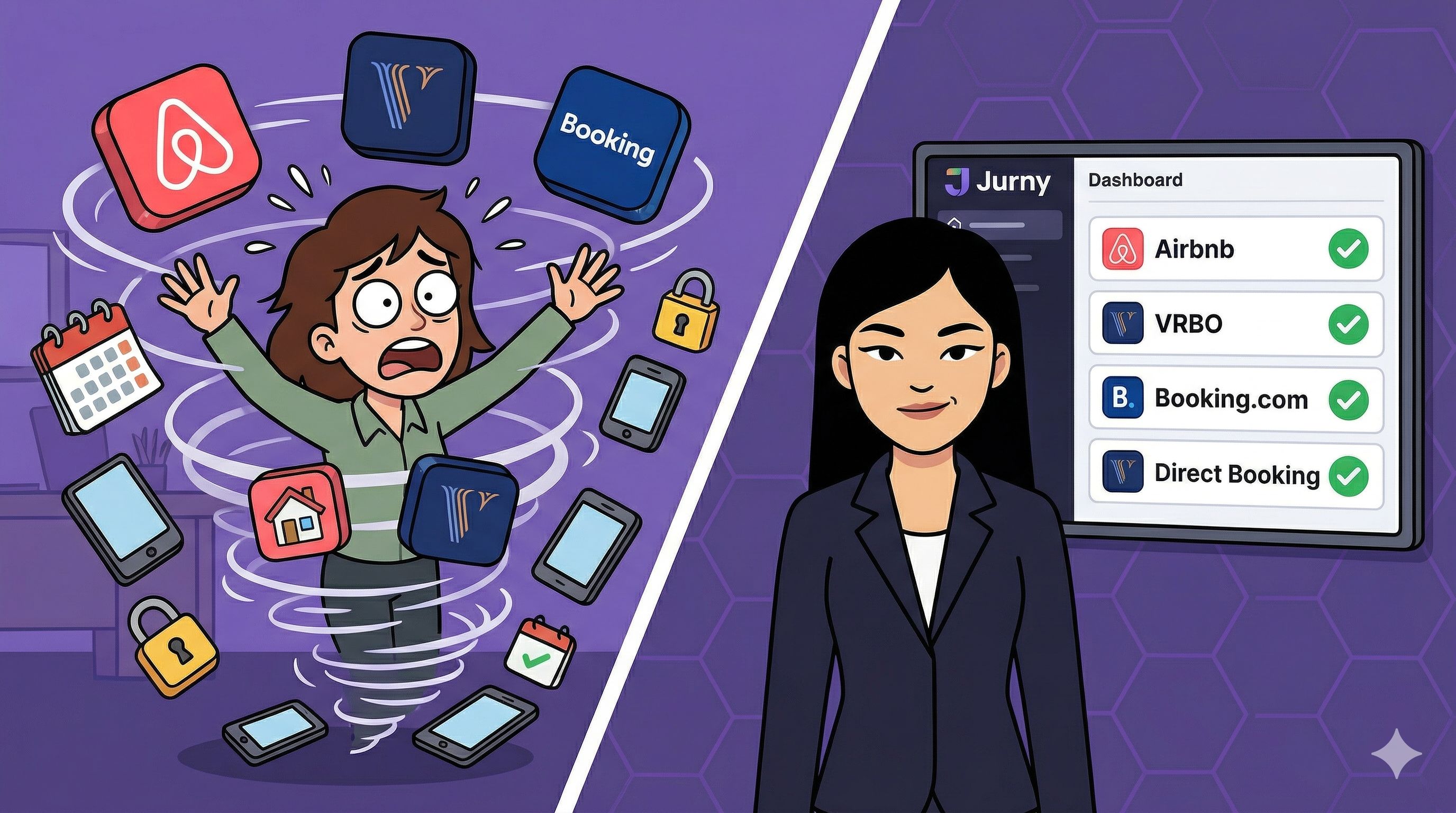
In practice, that means you can list on Airbnb, Booking.com, Vrbo, and your own site simultaneously, manage everything from one dashboard, and use NIA's AI to automatically adjust pricing across channels based on demand — so you're never leaving margin on the table.
- See Jurny's direct booking features
- How Jurny's revenue optimization tools work
Frequently Asked Questions
What percentage of bookings should be direct vs. OTA?
There's no universal rule, but most professional operators target 30–50% direct bookings as a healthy ratio. Below 20% and you're heavily exposed to OTA algorithm changes. Above 70% requires significant marketing investment to sustain. The right number depends on your portfolio size, market, and how much you've invested in your direct brand.
Do direct bookings really make more money than OTA bookings?
Yes — structurally. Every direct booking saves you 15–20% in OTA commission. On a $1,500 booking, that's $225–$300 back in your pocket. Over a year, across multiple units, that compounds into meaningful margin improvement. The caveat is that direct bookings require upfront investment in a website, booking engine, and guest acquisition strategy.
Will reducing OTA exposure hurt my occupancy rate?
In the short term, possibly. OTAs provide instant access to a global guest audience that takes time to replicate through direct channels. The smart approach is to build direct incrementally — starting with repeat guests and referrals — rather than cutting OTA inventory. Over 12–18 months, most operators can grow direct bookings without sacrificing overall occupancy.
How do I prevent double bookings when listing on multiple OTAs and direct?
A channel manager with real-time two-way sync is the only reliable solution. iCal sync has a 15–30 minute lag that creates double-booking risk. API-connected channel managers update all calendars instantly when a booking lands anywhere. Jurny's channel manager uses native API connections to Airbnb, Booking.com, Vrbo, and 90+ other platforms for exactly this reason.
What's the best way to convert OTA guests into direct bookers?
The highest-converting touchpoint is the pre-arrival and in-stay experience. A digital guidebook that includes your direct booking link and a small incentive (early check-in, loyalty discount) turns a one-time OTA guest into a future direct booker. The second-best lever is a post-checkout follow-up message — most guests who had a great stay are open to booking direct next time if you make it easy.
Ready to Build a More Balanced Distribution Strategy?
Jurny's platform combines a direct booking website, real-time channel management across 90+ OTAs, and AI-powered pricing intelligence — all in one place. See how operators are using jOS to reduce commission dependency and grow direct revenue. Book a Demo Today!
Explore Jurny: