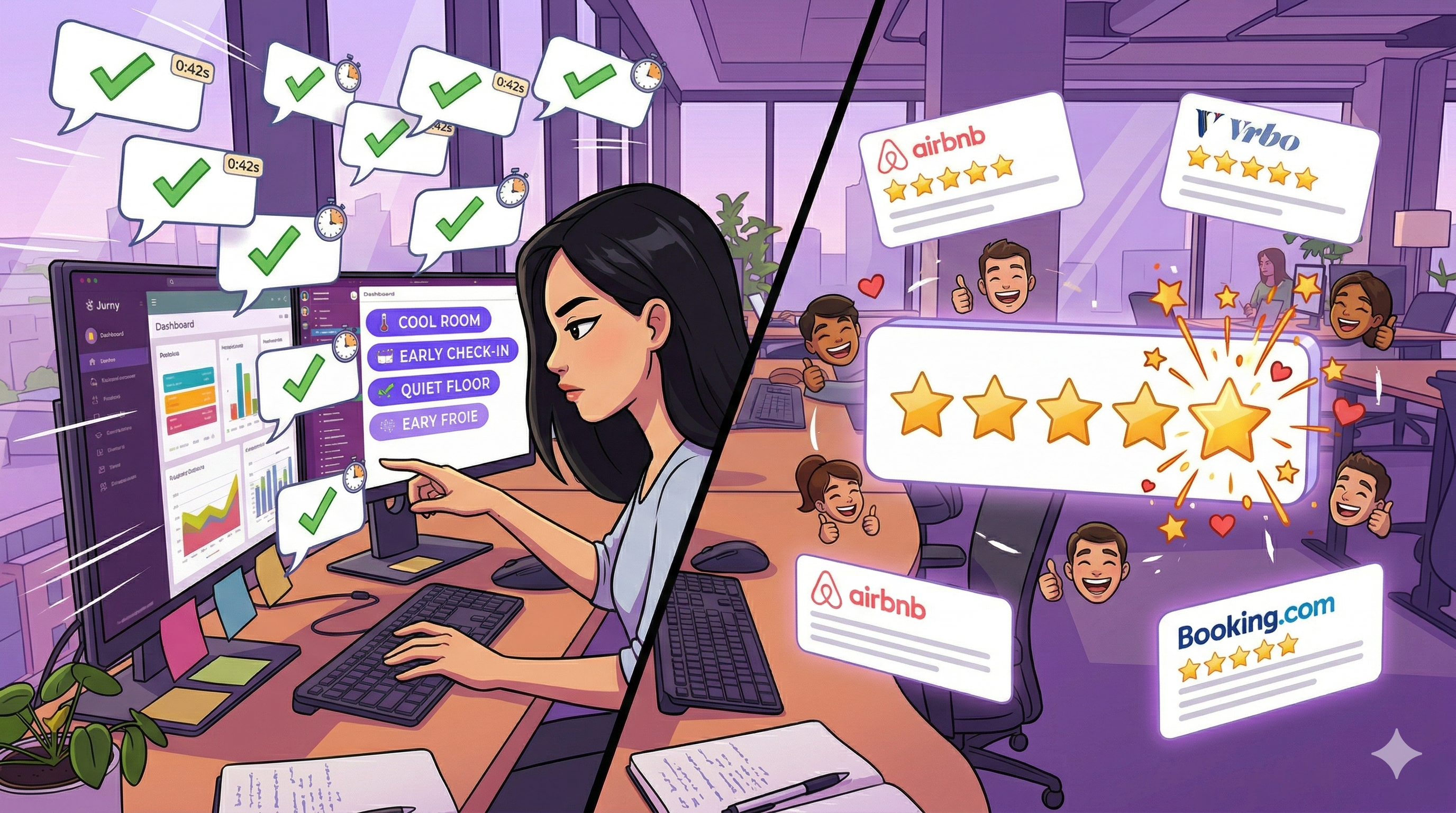

Quick Answer: The most cost-effective booking you'll ever take is from a guest who's already stayed with you and had a great experience. Converting one-time OTA guests into repeat direct bookers requires a systematic post-stay communication strategy and a compelling reason to bypass the OTA for their next reservation.
Every guest who books through Airbnb, Vrbo, or Booking.com and has a great experience is a potential direct booking for their next trip. They know you, they trust you, and they're significantly more likely to book again than a cold prospect.
But most operators let those guests go. The stay ends, the review comes in, and the relationship disappears — back into the OTA's platform, to be recharged commission fees if the same guest ever decides to return.
Why Repeat Guests Are Your Most Valuable Booking Source
The economics of a repeat direct booking are compelling compared to any other booking source:
- No OTA commission on the transaction — saving 3-15% depending on platform- Lower effective cost of acquisition than any paid or organic channel
- Higher average booking value — repeat guests tend to stay longer and spend more
- Lower pre-arrival coordination burden — they know your property and require less hand-holding
- Higher review quality — repeat guests leave more specific, credible reviews
The challenge is that OTA platforms are specifically designed to prevent you from building this relationship outside their ecosystem. The window to capture it is the stay itself and the period immediately after checkout — when the guest's experience is fresh and you have legitimate communication with them.
The Post-Stay Communication Sequence That Converts
Step 1: The Post-Checkout Thank You (Within 48 Hours)
Within 48 hours of checkout, send a personal thank-you message. Not a generic form letter — something that feels genuinely warm rather than automated. Include a request for a review (timed to 2-4 hours post-checkout for optimal response rate) and your direct contact information or booking website for future stays.
The goal of this message is two things: capturing their email address legitimately and planting the seed of a direct booking relationship.
Step 2: The Direct Booking Incentive (3-7 Days Post-Checkout)
Three to seven days after checkout — when the memory of the stay is still warm but the urgency of return travel isn't yet present — send a follow-up with a direct booking offer. Make the value proposition explicit: as a past guest, you can book your next stay directly with us at a special rate with no OTA fees, and you'll have access to early check-in and other perks.
The offer should be concrete and time-limited. Book within the next 30 days for your next trip and save a specific amount converts better than an open-ended standing offer because it creates urgency without feeling high-pressure.
Step 3: The Seasonal Re-Engagement (60-90 Days Before Peak Season)
Sixty to ninety days before your market's peak booking season, reach out to past guests who haven't returned yet with a first-access offer. Peak summer dates are filling up — as a past guest, you get early access before we open the calendar to everyone else.
This works for two reasons: it creates genuine scarcity framing (peak dates really do fill), and it rewards past guests with access that has tangible value. The segment most likely to respond is guests who stayed during a similar season in the past.
Step 4: The Anniversary Touchpoint
On or near the anniversary of a guest's stay, a brief touchpoint — it's been a year since your stay with us, and we'd love to have you back — generates meaningful re-engagement with minimal effort. This keeps your property top of mind for guests who travel on annual patterns.
What Makes Guests Choose Direct Over OTA for Return Stays
The direct booking offer needs to address the real reason guests default to OTAs even for return stays: trust and convenience. OTAs offer buyer protection, familiar interfaces, and easy payment processing. Your direct booking channel needs to offer something that meaningfully outweighs that comfort.
The most effective direct booking incentives for return guests:
- Guaranteed early check-in at no charge — high perceived value with low actual cost
- A loyalty discount of 10% or more — below 5% often feels too small to overcome OTA inertia
- A welcome gift or room upgrade for return guests
- Flexible cancellation terms superior to OTA standard policies
- A direct line to you for questions — not a messaging platform intermediary
Building the System That Does This at Scale
Manually executing a post-stay sequence across 30 guests per month is unsustainable. The operators building significant repeat direct booking revenue are doing it through automated sequences that fire from the booking event — post-checkout message sends automatically, follow-up triggers on a schedule, and seasonal re-engagement emails deploy to a segmented list.
This requires two things: a CRM or email marketing tool that holds guest contact data, and an automation layer that sequences the communications without manual initiation. Most modern PMS platforms, including Jurny, support this workflow through integration with email tools or native automation functionality.
How Jurny Supports Your Repeat Guest Strategy
Jurny's NIA handles the post-stay communication sequence automatically — sending thank-you messages, review requests, and direct booking follow-ups on the right timing without manual triggers. The platform captures guest data from each stay and supports segmented re-engagement campaigns, giving property managers the infrastructure to build a repeat direct booking channel that runs in the background.
Frequently Asked Questions
Can I contact past OTA guests directly for direct booking offers?
OTA terms generally prohibit soliciting guests to book outside the platform during or immediately after the OTA-facilitated stay, and prohibit sharing direct contact information before the booking is confirmed. The compliant approach is to make your direct booking option visible during the stay through a guest welcome book, and to communicate via the OTA messaging system within the permitted window. Post-stay, check each OTA's current terms for what is allowed.
What discount should I offer to encourage direct repeat bookings?
10% tends to be the threshold where guests feel the offer is meaningfully different from their OTA experience. Below 5% often fails to overcome the inertia of returning to a known platform. Consider pairing a modest discount with a high-perceived-value perk — early check-in, welcome gift — rather than offering a large price discount alone.
How long does it take to build a meaningful repeat direct booking channel?
Most operators see meaningful volume from repeat direct bookings 12-18 months into a systematic effort. The channel compounds — the guest list grows with every OTA booking, making each season more valuable than the last. If 15-20% of your past guests eventually return direct and you have 150-200 stays per year, you're generating 22-40 direct bookings annually from the channel alone within two years.
What email tools work best for vacation rental guest re-engagement?
Mailchimp, ActiveCampaign, and Klaviyo are commonly used by STR operators for guest email lists. The key capabilities you need: list segmentation by property, stay date, and guest type; automated sequence triggers; and clean unsubscribe management. Most PMS platforms can export guest data that feeds these tools.
Should I offer a loyalty program for repeat vacation rental guests?
A formal loyalty program makes most sense for operators with larger portfolios in the same market where guests have multiple property options. For smaller portfolios or geographically dispersed properties, a simpler past guest benefits approach — consistent perks for return direct bookers — often converts just as well without the administrative overhead of a formal program.
Turn Every Great Stay Into a Future Direct Booking
Jurny's automated post-stay sequences and guest communication tools handle the repeat booking engine so you don't have to. Book a demo today! →
Explore Jurny: