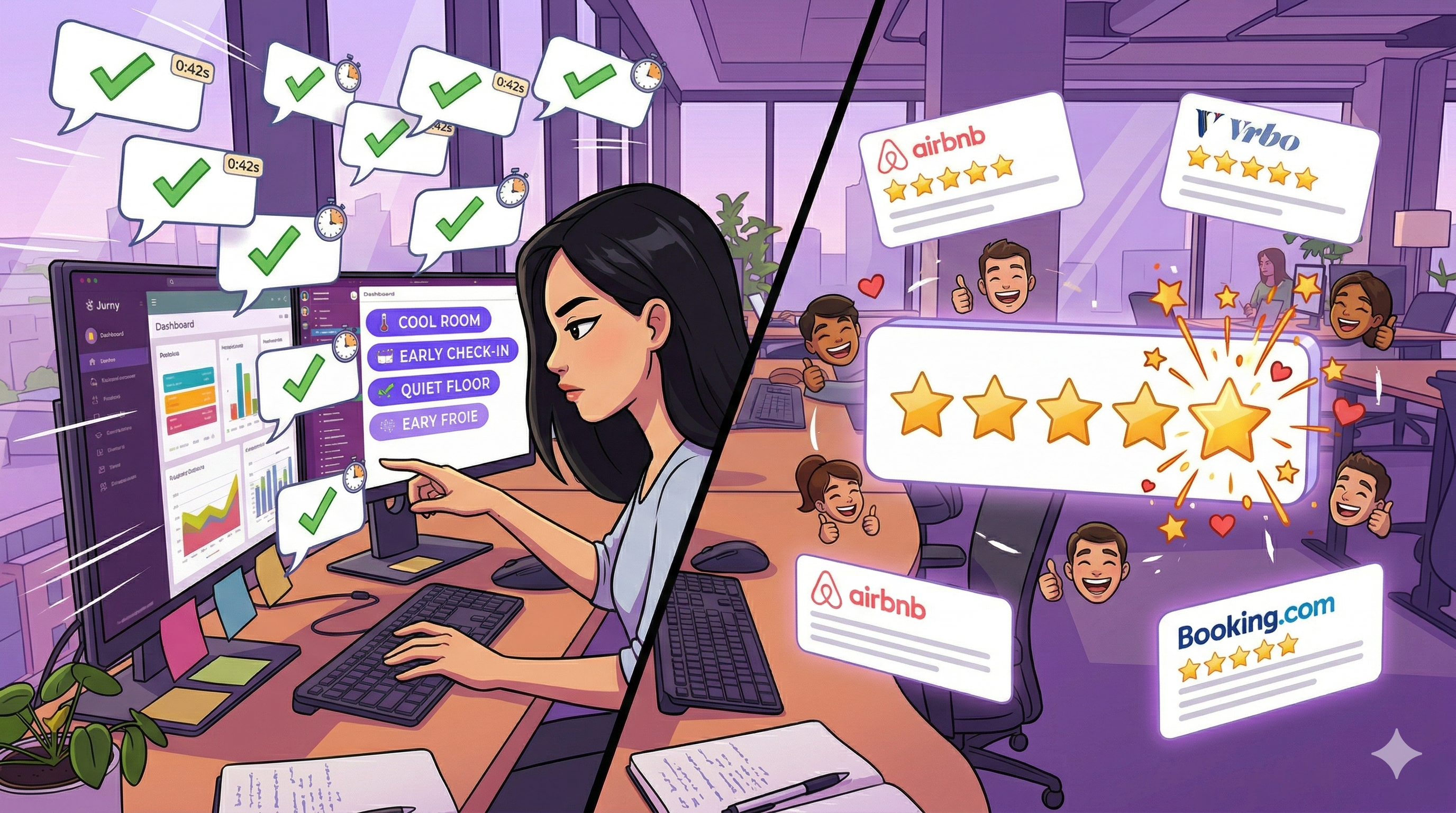

Guest satisfaction at one vacation rental property is about hospitality. Guest satisfaction across fifteen or more vacation rental properties is about systems. The operators who consistently maintain 4.8 and 4.9 review averages across large portfolios are not simply more attentive than everyone else. They have built operational infrastructure that delivers a reliably excellent experience at every property, for every guest, without depending on individual effort or memory.
This distinction matters because the strategies that work at one property — being personally responsive, remembering guest preferences, catching issues before they escalate — cannot survive contact with portfolio scale unless they are encoded into automated systems. The question is not whether to automate. The question is what to automate and how to do it in a way that feels human rather than robotic.
Understanding What Actually Drives Negative Reviews
Most operators intuitively know that five-star reviews come from great stays. What is less intuitive is understanding the specific failure modes that generate one and two-star reviews, because preventing those is more controllable than engineering exceptional moments.
Analysis of negative vacation rental reviews consistently reveals the same root causes:
Slow or absent communication: Guests who cannot reach their host when something goes wrong — or who wait hours for a response to a simple question — leave reviews that reflect that frustration regardless of the property's physical quality.
Check-in failures: Access code issues, unclear instructions, unexpected parking situations, WiFi that does not work as described. These failures happen in the first 30 minutes of a stay and set a negative tone that colors everything that follows.
Unmet expectations: Guests who booked based on listing photos or descriptions and found something materially different — a view that was exaggerated, an amenity that was listed but unavailable, a noise level that was not disclosed.
Ignored issues: Maintenance problems that were reported but not addressed promptly. Guests understand that things break. What they do not forgive is feeling ignored when they report it.
Every one of these failure modes is preventable with the right operational systems.
Response Time: The Single Highest-Impact Variable
OTA algorithms factor response time into search ranking. Guests rate hosts lower when they feel unattended. And the questions guests ask are, overwhelmingly, the same questions every other guest asks: WiFi password, parking instructions, early check-in availability, how to operate the smart lock.
At 15+ properties, manually answering every guest message within minutes is not a realistic standard to maintain. The solution is an AI guest messaging tool that responds instantly, accurately, and in the guest's language — 24 hours a day, seven days a week, across every channel simultaneously.
NIA (Network of Intelligent Agents) handles the vast majority of guest interactions autonomously, learning from every conversation and improving over time. Operators using NIA report handling over 90% of guest communication without manual intervention, with average response times under 60 seconds. This does not just protect review scores — it frees the operator's attention for the conversations that genuinely require human judgment.
Pre-Arrival Preparation: Eliminating the Most Common Failure Point
Check-in failures are the single most preventable category of guest dissatisfaction. A guest who arrives to find their access code does not work, or who spends 20 minutes trying to find parking, or who cannot figure out how to connect to WiFi is already writing a version of their review before they have even put down their bags.
The antidote is comprehensive, property-specific information delivered at exactly the right time. Digital Guidebooks that cover every property detail — access instructions, appliance guides, parking specifics, local recommendations, house rules — and that are delivered automatically on the morning of check-in eliminate the most common arrival friction points.
At scale, these guidebooks need to be property-specific and always current. A guidebook that references an amenity that was removed three months ago, or that has the wrong WiFi password after a router replacement, creates exactly the kind of unmet expectation that produces negative reviews. NIA keeps guidebook content accurate by learning from the questions guests actually ask, flagging when information appears to be outdated based on recurring questions.
Issue Resolution: Speed Is What Guests Remember
At 15+ properties, something will always be going wrong somewhere in the portfolio. A guest reports a broken air conditioning unit. A dishwasher is leaking. The hot water takes too long to heat up. These are not exceptional events — they are the ordinary background noise of managing properties at scale.
What separates operators who earn five stars despite maintenance issues from those who earn three stars is speed of resolution and quality of communication while the issue is being addressed. A guest whose reported issue is acknowledged within minutes, given a realistic resolution timeline, and followed up on proactively will almost always rate the stay positively despite the issue — because the response demonstrated that someone was paying attention.
NIA's sentiment analysis detects urgency in guest conversations and automatically escalates high-priority issues to the appropriate human contact. This ensures that genuine problems get immediate human attention while routine questions continue to be handled automatically — creating the right balance between operational efficiency and genuine care.
Mid-Stay Touchpoints: Proactive Service Without the Labor
The best hospitality feels anticipatory. Guests feel well taken care of not because staff is hovering, but because the right things happen at the right moments without them having to ask. At scale, this level of proactive service is only achievable through automated touchpoints timed precisely to each reservation.
A mid-stay check-in message — not a transactional one, but one that genuinely asks whether the guest has everything they need and offers relevant local recommendations — converts into positive review mentions at meaningful rates. AI-powered upsells delivered at the right moment during a stay generate both incremental revenue and the kind of "they thought of everything" impression that drives five-star reviews.
The Review Request: Timing Is Everything
Guest review rates are heavily influenced by when the review request arrives. A request sent within two hours of checkout, while the positive feelings from a good stay are still fresh, consistently outperforms requests sent the following day or later. The difference between a 35% review rate and a 60% review rate across a portfolio translates to hundreds of additional reviews per year — each one compounding into improved OTA search ranking and higher booking volume.
NIA sends post-checkout messages at precisely the right moment, personalized to reference elements of the stay, making each guest feel appreciated rather than processed. At scale, this level of timing and personalization is only possible through automation.
Building Systems That Earn Five Stars
The operators who consistently maintain exceptional review scores across large portfolios are not exceptional people doing exceptional things manually. They are operators who have built systems that reliably deliver excellent experiences — fast responses, frictionless check-ins, proactive communication, and rapid issue resolution — for every guest, at every property, without depending on anyone remembering to do it.
Jurny's AI-native platform provides the infrastructure for all of it: NIA for autonomous guest communication, Digital Guidebooks for pre-arrival preparation, AI-powered upsells for mid-stay service, and automated review request timing for post-checkout follow-up.
If you are managing 15+ properties and want to systematically drive your review scores higher without adding headcount, book a demo to see how Jurny automates the guest experience from first message to final review.
Explore Jurny: