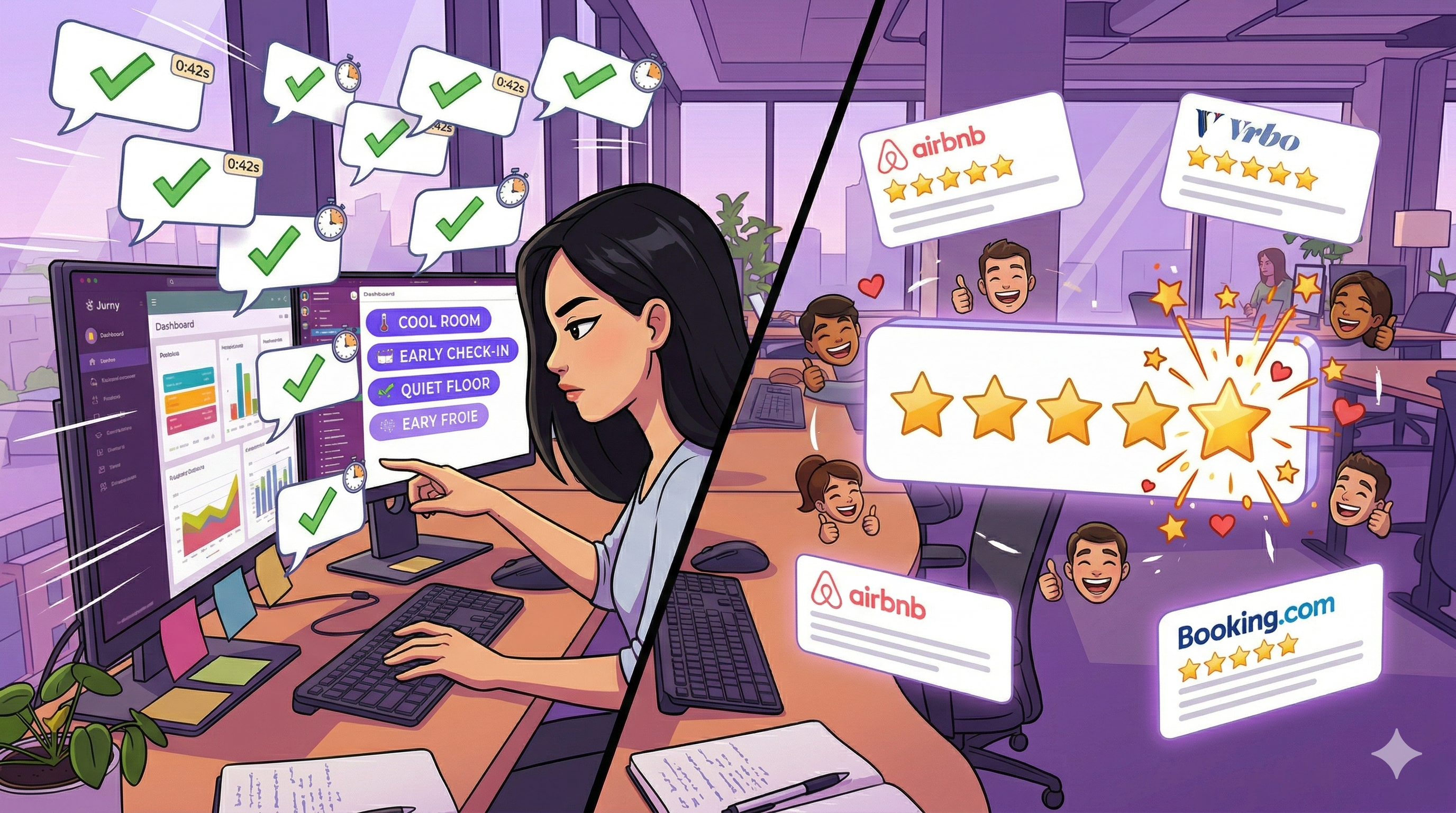

Quick Answer: AI guest communication in vacation rental management handles the full spectrum of guest messages — from routine pre-arrival questions to mid-stay issues to late-night emergencies — with distinct handling logic for each type: autonomous resolution for standard inquiries, intelligent escalation with full context for situations requiring human judgment.
If you've managed short-term rentals for any length of time, you know that guest messages don't follow a schedule. They come in during dinner, during school pickups, at 11:30pm when a guest can't get the door to open, and at 6am when someone wants to know if they can check in early.
The promise of AI guest communication is that it handles all of this — without you. But the more useful question is: how does it handle different types of messages? Because not all guest messages are the same. Some are routine. Some are urgent. Some are emotional. Some require judgment.
Here's a breakdown of how a well-implemented AI system handles every major category of guest communication in a vacation rental context.
Category 1: Pre-Arrival Logistics (The Most Common)
These are the messages that make up the majority of all guest communication: questions about arriving, accessing the property, and getting settled.
"What's the check-in time?" / "Can we check in early?" AI checks the property's availability window before arrival and either confirms early check-in if the property is ready (and optionally presents it as a paid upsell) or explains when the property will be available and what to do in the meantime.
"What's the door code?" AI delivers the access code specific to that booking — generated for the guest's exact stay dates — with the exact keypad entry instructions for that property's lock.
"Where do we park?" AI pulls the parking instructions from the property knowledge base — including street parking details, permit requirements, or private parking directions — and delivers them as clear, step-by-step instructions.
"Can I get check-in instructions?" AI delivers the complete pre-arrival package: address, parking, access code, entry sequence, WiFi credentials, and a note inviting questions.
Resolution: autonomous. Response time: under 60 seconds.
Category 2: Property Orientation Questions
Once guests arrive, they explore the property. Questions follow about how things work.
"What's the WiFi password?" AI delivers the current WiFi name and password for that specific property. If the guest is having connection issues, AI provides troubleshooting steps and escalates if the issue suggests a hardware problem that needs on-site attention.
"How does the [TV / thermostat / dishwasher / BBQ] work?" AI pulls appliance and amenity instructions from the property knowledge base and delivers them in clear, step-by-step format. For properties with digital guidebooks, AI can direct guests to the specific section.
"Where are the extra towels / blankets / trash bags?" AI knows the inventory and storage configuration documented for each property and directs guests accurately.
Resolution: autonomous for documented items; escalated if the question involves something not in the knowledge base. Response time: under 60 seconds.
Category 3: Local Recommendations
Guests staying in a new location often want local intelligence — where to eat, what to do, how to get around.
"Where should we have dinner?" AI draws from the property's curated local recommendations, filtered by any context the guest has provided (type of cuisine, budget, occasion). It responds conversationally, not like a list dump.
"What's worth doing nearby?" AI recommends activities, attractions, and experiences from the property's local guide, personalized to the guest's stated interests if known.
"How do we get to [location]?" AI provides directions or transportation options, pulling from the property's local knowledge base.
Resolution: autonomous. This is one of the highest-rated interaction categories in guest reviews — personalized local knowledge delivered instantly.
Category 4: Mid-Stay Issues
Something goes wrong. The most important thing is immediate acknowledgment and intelligent triage.
Maintenance issues (minor): A dripping faucet, a squeaky door, a light bulb out. AI acknowledges the issue, apologizes for the inconvenience, logs a maintenance task in the system, and assures the guest it will be addressed. If it's something the guest can resolve themselves (a tripped circuit breaker, a reset for a smart device), AI provides the instructions first.
Maintenance issues (significant): No hot water, a broken AC in summer, a lock that isn't working. AI acknowledges immediately, escalates to the property manager with a flagged urgent alert, and keeps the guest informed that someone will follow up within a defined timeframe. The guest is never left without an immediate response.
Neighbor or noise complaints: AI responds with empathy, addresses what the guest can control, and escalates to the property manager for situations requiring direct intervention.
Resolution: mixed. Acknowledgment is always immediate and autonomous. Resolution routing depends on severity.
Category 5: Late-Night Messages
This is the category that wakes property managers up. A guest locked out at midnight. A maintenance emergency at 11pm. A dispute about house rules at 10:30pm.
For a property manager without AI, every one of these requires immediate personal involvement — regardless of what's happening in their personal life.
With AI: the guest receives an immediate response the moment they send the message. If it's a routine question (forgot the door code, needs WiFi again), AI resolves it fully. If it's an emergency that requires a human — a guest who genuinely can't get in despite following all instructions correctly, a safety issue — AI escalates with full context and a notification to the on-call team member.
The critical difference: the guest is never left waiting. The escalated message arrives to the right person with everything they need to act immediately, rather than a raw message with no context at 11pm.
Category 6: Checkout Communication
"What time is checkout?" AI confirms checkout time, provides any checkout instructions (door lock, trash protocol, key return if applicable), and wishes the guest a safe journey.
"Can we check out late?" AI checks whether the property has an open window after the guest's departure. If available, it either approves a late checkout or offers it as a paid add-on. If not available, it explains why and offers the earliest alternative.
"We've checked out" or confirmed departure: AI triggers the operational sequence: cleaning notification sent, access code deactivated, next guest's code prepared, property status updated. Review request scheduled for 2–4 hours post-checkout.
Resolution: autonomous. Response time: under 60 seconds.
Category 7: Edge Cases and Unusual Requests
No AI system handles 100% of messages perfectly. The honest picture is that 70–90% of vacation rental guest inquiries are standard enough for reliable autonomous resolution. The remaining 10–30% involve situations that benefit from human judgment.
A well-designed system handles this well: the guest receives an immediate acknowledgment, the message is categorized and flagged with relevant context, and the property manager receives a notification with everything they need to respond. The guest experience of the escalation is seamless. The property manager's experience is efficient.
How Jurny's NIA Handles All of This
NIA is Jurny's AI engine that manages the full communication lifecycle described above. It operates across all channels simultaneously, pulls accurate property-specific context for every response, and escalates intelligently with full context when situations require human judgment. For operators who currently handle any portion of this communication manually, NIA is designed to take over the full digital communication layer from day one.
Frequently Asked Questions
Can AI guest communication handle messages in multiple languages?
Yes. NIA responds in +45 languages. For operators with international guests across different OTAs, this eliminates the language barrier that often forces manual intervention.
What happens when a guest is frustrated or angry in their message?
NIA is trained to recognize emotional tone and respond with appropriate empathy before addressing the practical issue. For messages with significant emotional weight — a genuinely upset guest with a legitimate complaint — NIA's escalation threshold is lower, ensuring a human takes over the conversation with full context rather than having AI attempt to de-escalate a situation that benefits from human connection.
How does AI handle a guest who keeps asking the same question despite receiving an answer?
This pattern is typically a signal that the answer provided wasn't sufficient — either because the guest is confused, the information was unclear, or there's a real problem that the information didn't resolve. NIA recognizes repeat question patterns and escalates to a human for follow-up, rather than repeatedly sending the same response.
What is the guest experience when AI escalates to a human?
The guest receives an immediate acknowledgment from NIA — confirming their message was received and that a team member will follow up shortly. This eliminates the experience of a message going unanswered. The property manager then receives the flagged message with context and can respond quickly with everything they need.
Can guests know they're talking to an AI?
The platform can be configured for full transparency — disclosing that the initial response is AI-generated — or to present responses under the property brand without explicit AI labeling. The choice is yours. In either configuration, escalated messages are handled by a human, which is always made clear to the guest.
Let AI Handle the Communication — You Handle the Exceptions
If you're still personally responding to routine guest messages, Jurny's NIA is built to take that off your plate entirely. Book a demo today! →
Explore Jurny: