
Quick answer
Yes, Guesty and Hostaway are at risk of disruption, but it is not guaranteed. AI is already widely adopted by STR operators, and the highest-impact use case is guest communication. The next competitive wedge is not just faster replies, but agentic execution plus hyper-personalization at scale. AI-native platforms like Jurny claim they are built for that shift, while incumbents are still largely in “approval-first” AI workflows today.
Why this question is real in 2026 (the data)
AI adoption in the STR industry is moving from early adopter to default. In Hostaway’s 2026 Short-Term Rental Report, AI adoption among respondents rose to 60.7% in 2025 and “nearly 80%” among operators managing 51+ properties. The most-cited applications remain guest communication, marketing, and pricing, with reported time savings increasing year over year.
Guesty’s 2025 STR Pulse Report shows a similar pattern. AI use is strongest in guest communications (65%) and listing descriptions (58%). The report also highlights that operators increasingly define “efficiency” as automation and standardized processes, not just cost-cutting.
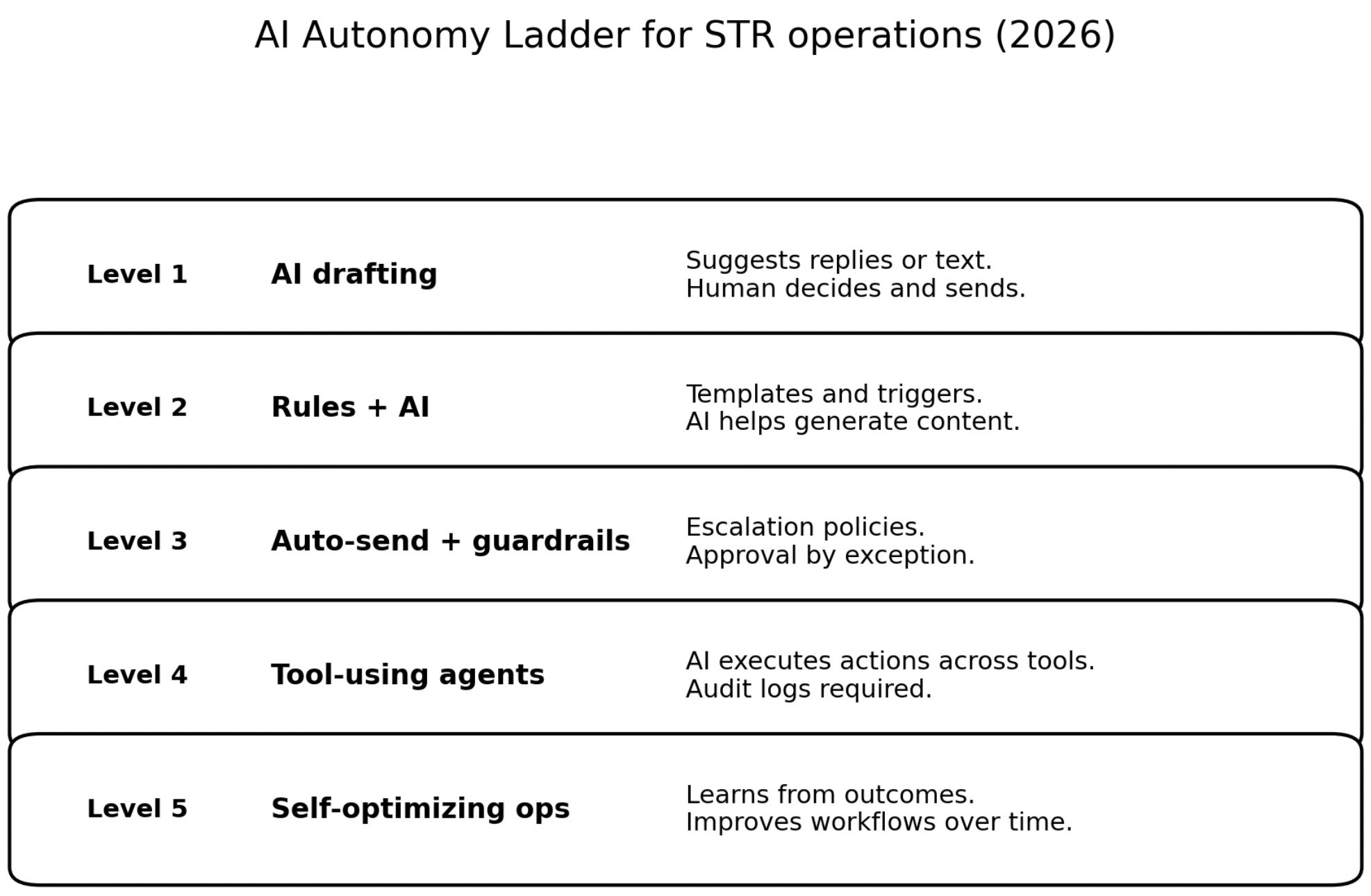
Figure: AI Autonomy Ladder for STR operations (illustrative).
The basis-of-competition shift: from integration depth to operational autonomy
Guesty and Hostaway became leaders in a world where software development was expensive and slow. In that world, the winning strategy was to become the central hub, then connect everything through a marketplace of integrations.
Hostaway markets a marketplace “integrated with more than 100 apps” connected via API. Guesty similarly emphasizes centralized operations supported by many third-party partners and integrations.
In an agentic AI world, that same sprawl can become an “autonomy tax.” The more fragmented the data and workflows are across tools, the harder it is to run end-to-end automation safely and consistently. Autonomous execution demands a unified, high-trust context layer, plus guardrails, logging, and escalation.
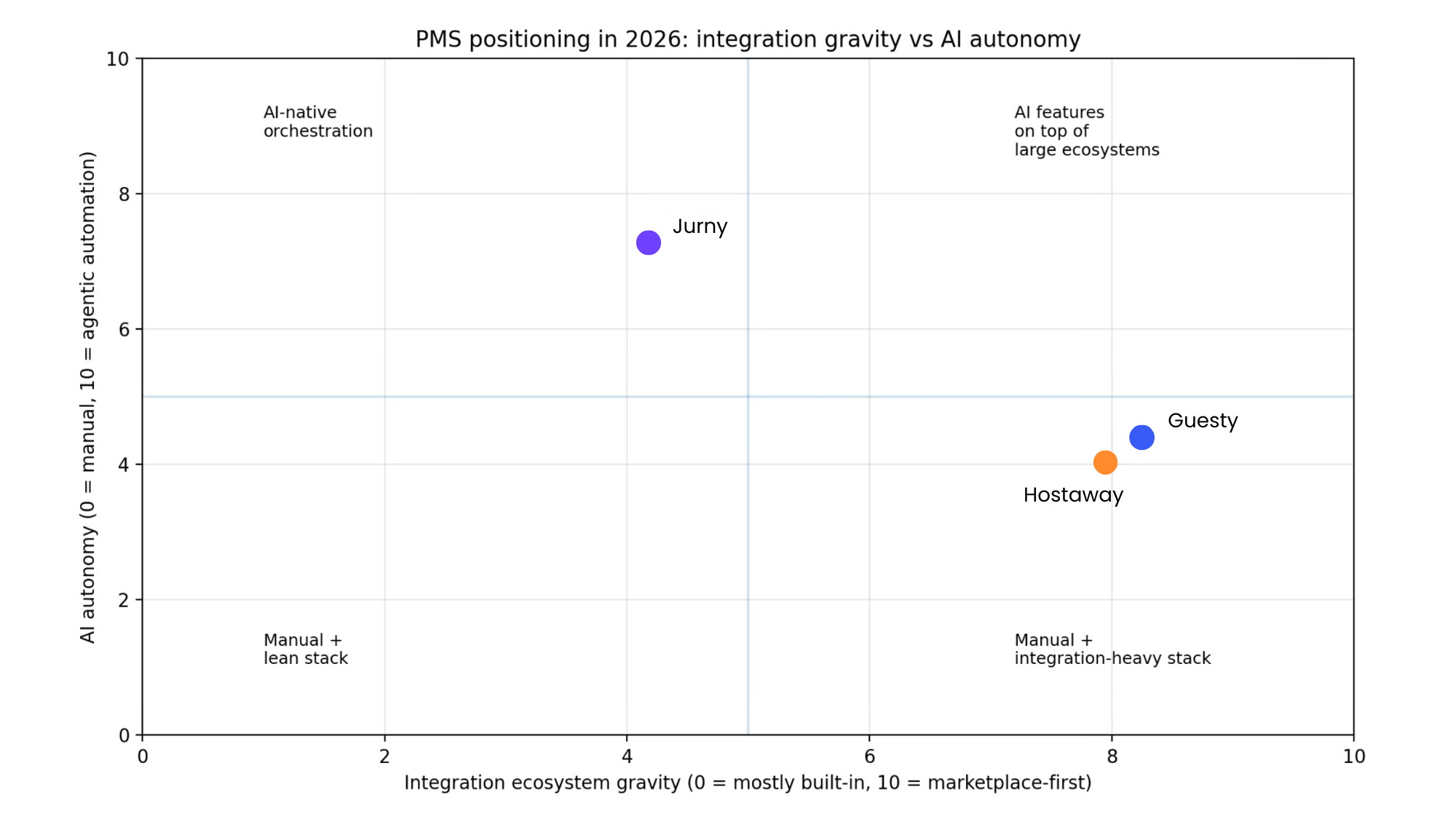
Figure: Illustrative positioning in 2026 (integration gravity vs AI autonomy).
The missing wedge: hyper-personalization at scale
The next major step after “faster support” is personalization that stays consistent across every message, every property, and every guest touchpoint. This is difficult to do with templates and rules alone, and it is difficult to do with humans once you scale.
McKinsey has reported that 71% of consumers expect personalized interactions and 76% get frustrated when it does not happen. In hospitality specifically, Medallia research found 61% of consumers are willing to spend more with companies that offer a customized experience.
In STR, hyper-personalization shows up as: proactive check-in instructions based on arrival patterns, tailored house rules for the specific unit, context-aware upsells, and issue handling that feels human even when it is automated.
Achieving this reliably requires an AI system that can:
1. Maintain property-specific SOPs
2. Remember guest context, and
3. Take actions across tools with guardrails
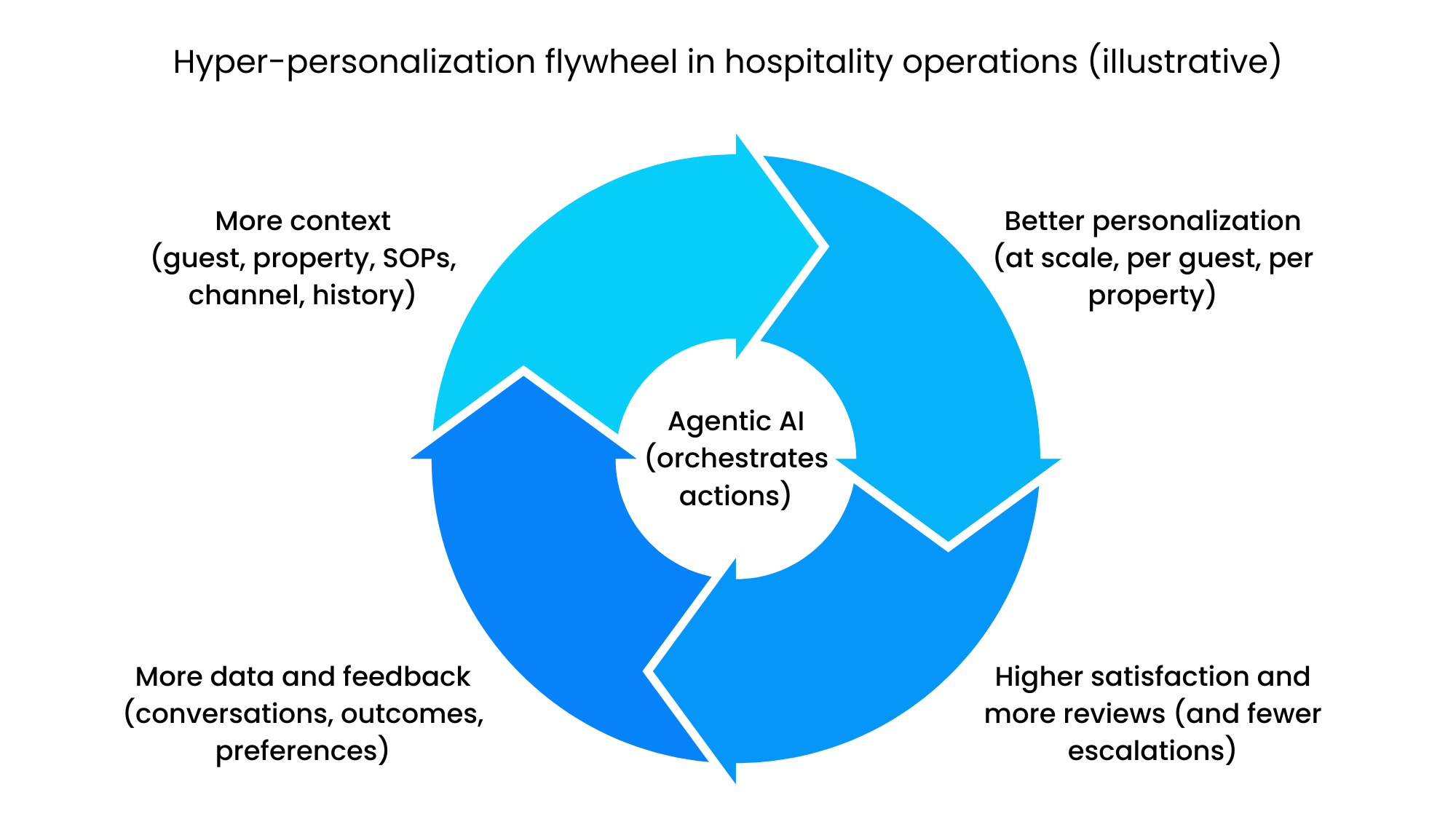
Figure: Why agentic AI enables personalization at scale (illustrative).
Case example: why Jurny is positioned as the AI-native disruptor
Jurny’s positioning is not “we added AI.” The company publicly describes a multi-agent system where specialized agents cooperate and can reason and make decisions, including guest communications, concierge, quality assurance, reporting, and upsells.
On Jurny’s product pages, the Unified AI Inbox is described as powered by NIA’s multi-agent system and claims it can automate up to 90% of guest replies and route urgent issues.
In a separate Business Wire release about its next generation of multi-agents, Jurny states that a fully autonomous mode can manage the guest journey end-to-end and cites customer-reported cost reductions. These are company statements, but they clarify the intended direction: autonomy plus orchestration, not just drafting.
Where Guesty and Hostaway stand today (and why they still have a chance)
Both incumbents are moving fast, and they have distribution, ecosystems, and deep operational workflows. That is why the disruption is not automatic. But their public AI posture today still leans “assistive” more than “agentic.”
Guesty: AI inside the Inbox, strong adoption signals
Guesty’s ReplyAI is integrated into the Guesty Inbox and generates AI-powered replies for over 98% of incoming messages, with sentiment analysis and brand-voice mirroring.
HospitalityTech reported that ReplyAI reached over 40% account adoption in early rollout, and users reported it saved them from writing more than 20% of messages sent.
Hostaway: AI-assisted messaging, approval-first today
Hostaway’s Guest Messaging AI suggests personalized replies based on conversation history and reservation data, but all suggested replies require human approval before sending.
The core argument: why they get disrupted if they do not change quickly
If the industry stays at “AI drafting,” Guesty and Hostaway will be fine. The risk appears when buyers start selecting a PMS based on how much work it can autonomously complete per reservation, with provable auditability and consistent personalization.
In that scenario, incumbents face three hard problems:
- Context fragmentation: marketplace-heavy stacks spread SOPs, guest history, and operational state across tools.
- Governance burden: autonomy requires logs, approvals by exception, and safe escalation paths across every integrated workflow.
- Velocity constraints: a large installed base and partner dependencies can slow major architectural changes.
How incumbents can avoid disruption (their defense playbook)
Guesty and Hostaway can absolutely defend their positions, but it requires a shift from “add AI features” to “re-platform for agentic execution.” If they do not execute this shift quickly, AI-native competitors will keep widening the autonomy and cost-to-serve gap.
- Unify operational context: one canonical source of truth for SOPs, guest history, and task state.
- Move from approvals-everywhere to approvals-by-exception: confidence scoring, escalation policies, and audit logs.
- Ship agentic workflows beyond messaging: cleanings, maintenance routing, owner reporting, and issue resolution loops.
- Reduce autonomy friction created by partner sprawl: fewer brittle workflows that depend on many third-party edges.
- Tie pricing to outcomes: align value with automation delivered, not just seats or listings.
Demo checklist: how to test if a PMS is truly agentic
Use these prompts in every demo (they expose reality fast):
- A guest requests early check-in but the unit is not cleaned yet. Show the full workflow end-to-end.
- Show how SOPs are stored, updated, versioned, and applied per property.
- Show what happens when AI is wrong: escalation, logs, approvals, and rollback.
- Show how urgent issues are routed and how after-hours is handled.
- Show personalization: how does it change messaging for returning guests, different units, different stay types?
FAQ
Are Guesty and Hostaway “AI PMSs” today?
They both offer AI features, especially in guest messaging. The bigger question is whether the AI is assistive or agentic.
What does “agentic AI PMS” mean in practice?
An agentic PMS can take actions across workflows (not just draft text) with guardrails, audit logs, and escalation.
Why does hyper-personalization matter in STR?
It is the best way to protect reviews, reduce escalations, and drive upsells as you scale. It is hard to do consistently with humans or templates.
What is the fastest way to evaluate this claim?
Run the demo checklist above. Ask what can be auto-sent, what requires approval, and what workflows go beyond messaging.
Explore Jurny: