
Managing one vacation rental property is a job. Managing 15 or more is an operation. The responsibilities don't just multiply — they transform. Tasks that worked manually at five units break down completely at fifteen, and the property managers who scale successfully are the ones who build systems, not just work harder.
Core Responsibilities That Scale
At 15+ units, a property manager's core responsibilities fall into six categories. Each one requires a different approach at scale than it does at one or five properties.
1. Guest Communication Management
At scale, guest communication is constant — inquiries at midnight, check-in questions on Sunday mornings, maintenance reports mid-stay, review responses after checkout. A single property manager handling 20+ units cannot respond fast enough to maintain the response rates OTAs reward. The Unified AI Inbox centralizes every message from every channel — Airbnb, VRBO, Booking.com, email, SMS, WhatsApp — and handles the majority of interactions automatically through NIA (Network of Intelligent Agents). Operators using NIA report handling over 90% of guest communication without manual intervention, with average response times under 60 seconds.
2. Channel Distribution
Keeping availability, pricing, and listing content synchronized across Airbnb, VRBO, Booking.com, and direct booking channels is a full-time job at scale. Manual updates create double bookings and rate inconsistencies. A dedicated channel manager handles this automatically — connecting to each OTA through direct API integrations rather than iCal, ensuring real-time availability updates the moment any booking is confirmed. For operators managing 15+ properties, this is not optional infrastructure. It is the foundation that makes scale possible without constant fire-fighting.
3. Dynamic Pricing and Revenue Management
Setting competitive nightly rates across 15+ properties with different markets, seasonal demand patterns, and local event calendars is analytically impossible to optimize manually. An operator who updates rates once a month leaves significant money on the table. Jurny's revenue management integration analyzes booking pace, competitor pricing, local events, and historical occupancy to adjust rates automatically — something no human team can do at the speed and granularity required. At scale, this is the difference between 68% and 78% occupancy across a portfolio, a gap that compounds into significant ARR over a year.
4. Maintenance Coordination
Property issues do not follow business hours. At scale, operators need systems that flag maintenance issues automatically, route them to the right vendors, and track resolution without manual oversight. Jurny's property care app connects directly with Turno and Breezeway to automate cleaning dispatch and maintenance workflows the moment a booking is created or updated — no manual coordination required. Combined with NIA's automatic issue escalation, no maintenance problem falls through the cracks regardless of when it is reported or which property it involves.
5. Guest Screening and Access Control
Verifying guest identity and managing smart lock access across dozens of properties requires automation. Manual key handoffs and ID checks do not scale. AI-powered guest screening verifies identity before check-in through an automated flow integrated directly into the booking confirmation process. Smart lock integrations generate unique access codes per reservation, delivered automatically at the right time through the guest messaging flow — no manual coordination required.
6. Reporting and Owner Communication
Property owners expect transparency. At scale, generating manual reports for each owner is unsustainable. Jurny's owner accounting and reporting features provide automated owner dashboards with real-time occupancy, revenue, statement generation, and maintenance updates. The NIA Data Scientist agent turns portfolio data into clear insights and revenue opportunities without requiring manual analysis. Monthly reporting that previously took hours per owner happens automatically.
The Shift from Operator to Systems Thinker
The most important mindset shift for a property manager scaling past 15 units is recognizing that the job is no longer primarily about doing tasks — it is about building systems that do tasks. The operators who scale to 50, 100, or 200 units are not the ones who work the hardest. They are the ones who delegate the most to software.
Every hour spent manually answering a guest question that a system could answer, manually updating a calendar that software could sync, or manually generating a report that could be automated is an hour that is not going toward portfolio growth, owner acquisition, or the decisions that genuinely require human judgment.
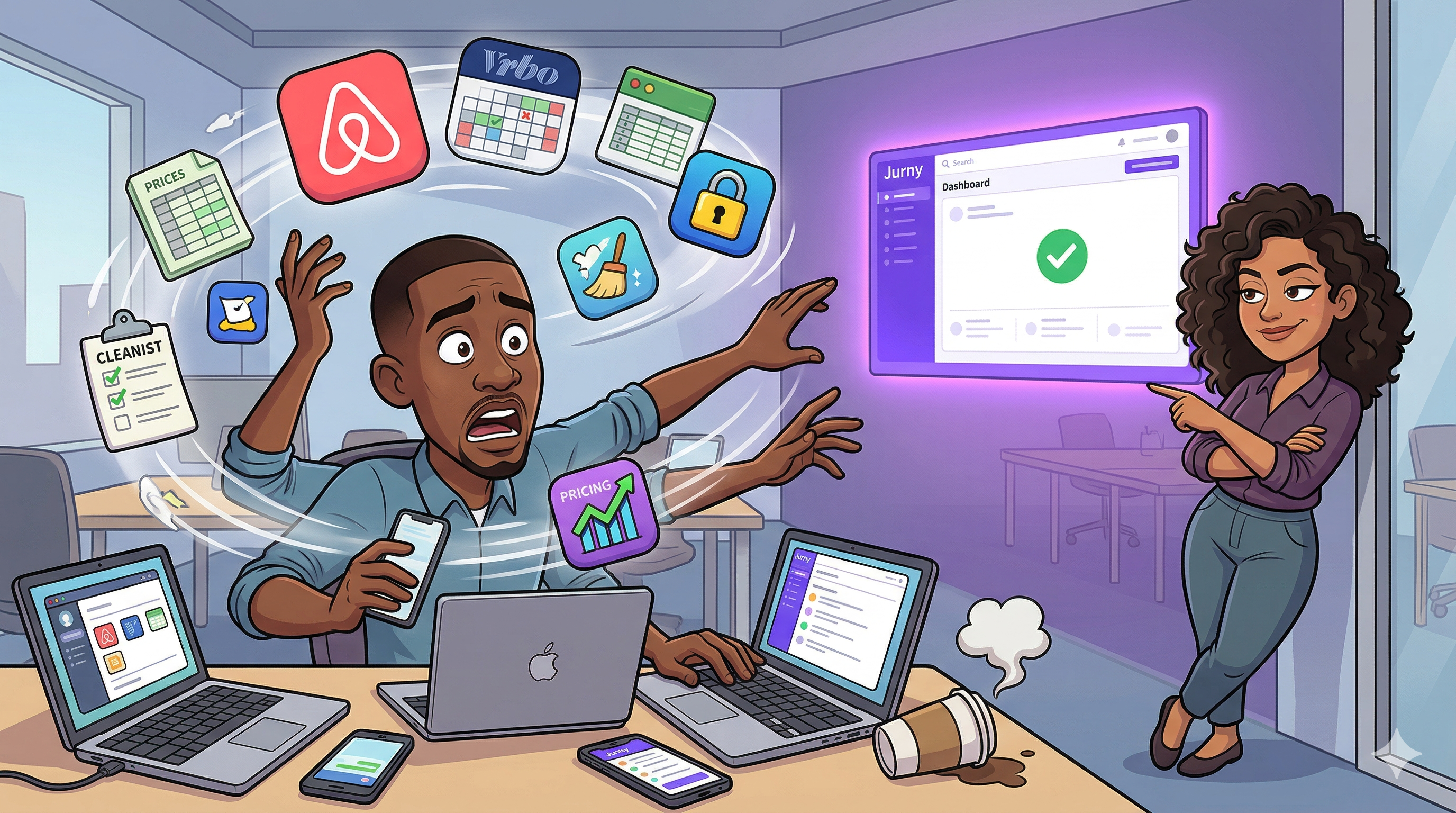
The right short term rental management software handles guest communication, distribution, pricing, maintenance, screening, and owner reporting autonomously — freeing operators to focus on the layer of work that actually grows the business. If you are managing 15+ units and still spending the majority of your time on operational tasks, the problem is not your work ethic. It is your infrastructure. Book a demo to see how Jurny handles the operational layer so you can focus on what matters.
Explore Jurny: