Picture this: a guest books a charming Airbnb in Austin. Before check-in, they strike up a friendly conversation with their host — "John" — asking about parking, early check-in, and the best nearby taco spots. The responses are fast, warm, almost eerily helpful. Then, mid-conversation, the guest asks a curveball question — something oddly specific — and the mask slips. The reply is robotic, looping, slightly incoherent.
The guest posts to Reddit. Screenshots go viral. A thousand comments pile in: "Your host is a bot and you never even knew."
And suddenly, property management has a PR problem.
But here's what that story actually tells us: the backlash isn't about AI. It's about bad AI, used badly.
AI-native property management — built from the ground up with intelligence at its core — isn't what guests are rejecting. They're rejecting the experience of being deceived by a chatbot duct-taped onto a property listing. They're rejecting the frankenstack: seven disconnected tools, none of which talk to each other, pretending to be a coherent host experience.
There's a massive difference between those two things. And for property managers operating at scale, understanding that difference isn't just a philosophical exercise — it's a competitive advantage.
The Real Problem Isn't AI — It's the Frankenstack
Most property managers didn't set out to deceive anyone. They set out to survive.
Managing 20, 30, 50 short-term rentals without automation is genuinely impossible at a human level. So operators cobbled together solutions: a channel manager here, a messaging tool there, a third-party chatbot plugged in via API, maybe a pricing tool, a cleaning scheduler, a review manager. Ten apps. Ten logins. Ten monthly invoices. Ten points of failure.
The "robot host" scandal isn't a story about AI. It's a story about what happens when you stack disconnected tools on top of each other and hope the seams don't show.
When a generic chatbot — trained on nothing specific to your property — answers a guest's question about your broken ice machine, it doesn't know the answer. It guesses. It loops. It fails. And the guest feels tricked — not because AI answered them, but because the AI clearly had no idea who it was supposed to be.
This is the fundamental flaw of bolt-on AI: it's a layer of automation applied over a broken system, not intelligence built into a coherent one. The operators catching heat on social media aren't using too much AI. They're using the wrong kind.
At Scale, the Human-Only Model Is a Fantasy
Let's be honest about the math.
A property manager running 50 units fields, conservatively, 200–300 guest messages per week. Check-in instructions, noise complaints, lock code issues, early departure requests, "where's the closest Whole Foods," late-night lockouts. If each message takes five minutes to handle, that's 1,000 to 1,500 minutes of communication work every single week.
That's 25 hours. Every week. Just on messaging.
And that's before you've touched pricing, maintenance coordination, cleaning turnovers, owner reporting, OTA management, or review responses.
The math doesn't work. It never worked. The operators who pretend it does are either burning out their staff, burning themselves out, or quietly cutting corners in ways that eventually show up in their reviews.
Scaling a short-term rental portfolio without automation isn't a badge of honor. It's a liability.
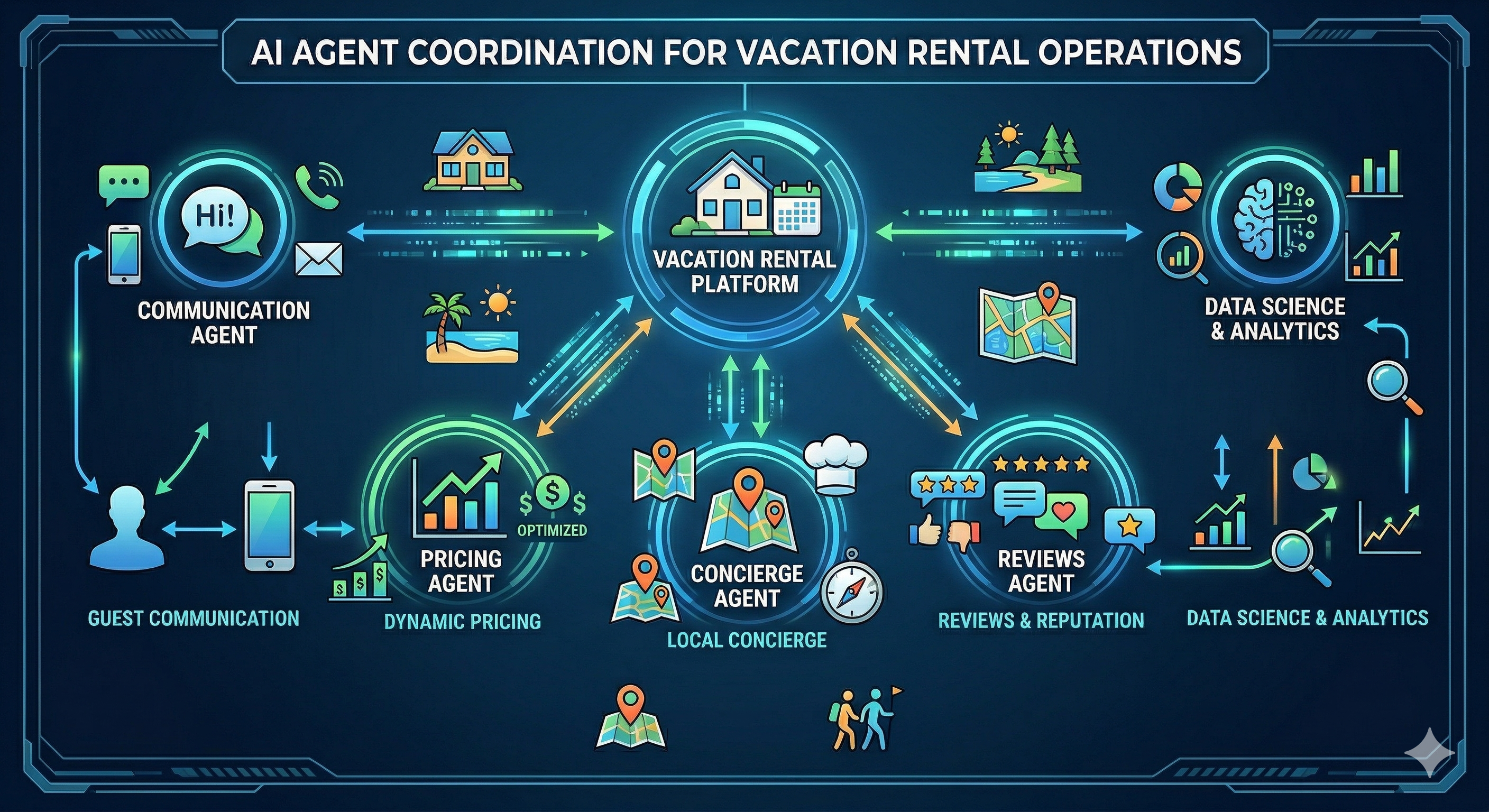
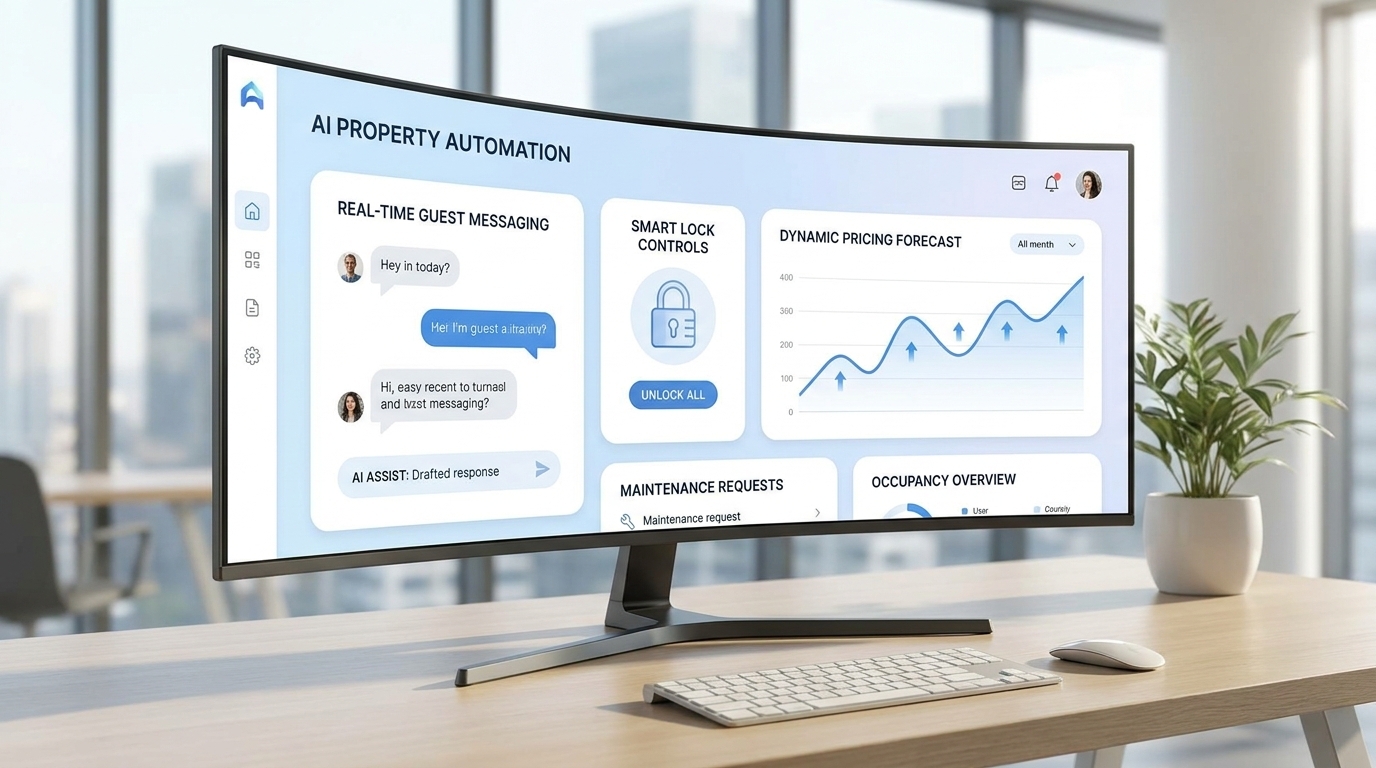
What AI-native property management does — done right — is replace not just the messaging function, but the entire operational stack. One platform. One intelligent layer. Channel management, dynamic pricing, guest communication, smart access, cleaning coordination, upsells, reviews — all connected, all informed by the same data, all running on the same intelligence.
That's not replacing a human host with a robot. That's giving one skilled operator the leverage to manage what used to require a team of six.
Transparency Is the New Trust Signal
Here's the counterintuitive truth buried in the "robot host" backlash: guests aren't actually opposed to AI. They're opposed to being lied to.
Survey after survey confirms it. When guests know upfront that responses are AI-assisted, satisfaction scores don't tank — they often improve, because response times are faster, answers are more accurate, and the experience feels more consistent. What guests hate is discovering, mid-conversation, that "John" doesn't exist.
The operators winning right now aren't hiding their AI. They're leading with it.
"Our property is managed by Jurny AI — you'll get instant, accurate answers 24/7" is not a warning. For the right guest — the one who books because they want a frictionless, self-serve experience — it's a selling point.
Think about it from the guest's perspective: which do you trust more — a "host" who takes 9 hours to reply to your 2 AM lock question, or an AI-powered platform that answers in under 60 seconds, correctly, every time?
The short-term rental industry has spent years trying to compete with hotels on the "personal touch" dimension. But hotels figured out long ago that consistency and reliability build more trust than warmth alone. An AI-native operation that delivers a five-star experience at scale will outperform a "human" operation held together with spreadsheets and good intentions.
Transparency about your AI isn't a liability. It's a positioning statement.
What AI-Native Actually Means
The term "AI property management software" gets thrown around loosely. Every PMS vendor slapped an AI badge on their product sometime in 2023. But there's a meaningful distinction between AI-added and AI-native — and it matters enormously when you're managing properties at scale.
AI-added means a traditional property management platform retrofitted with AI features. A chatbot module here. An auto-pricing suggestion there. The core architecture is the same legacy stack it always was — a database with a machine learning layer painted on top. These tools can reduce some manual work. They cannot eliminate operational chaos.
AI-native means the intelligence is the operating system. It's not a feature — it's the foundation. Every function, from the moment a guest inquires to the moment they check out and leave a review, runs through a unified intelligence layer that knows your property, your preferences, your pricing rules, your maintenance history, and your guest communication style.
When a guest messages at midnight asking if they can check out two hours late — an AI-native platform doesn't just auto-reply with a canned response. It checks the next booking's check-in time, evaluates the cleaning window, cross-references your late checkout fee policy, and either approves the request with the appropriate upsell or declines it gracefully, all in real time.
No human needed. No escalation required. No dropped ball.
That's not a chatbot. That's an operating system.
Jurny is built as the first AI-native OS for property managers — not a PMS with AI features, but an AI-first platform that replaces the entire stack of disconnected tools most operators are still cobbling together. It's designed specifically for operators with 15+ properties who have outgrown the spreadsheet era and need something that scales with them, not against them.
The difference between a Jurny-powered operation and a "robot host" situation isn't the presence of AI. It's the coherence of it. Want to see exactly how each piece of the platform works? Explore Jurny AI to understand what an AI-native OS looks like in practice.
The Operators Who Get This Are Already Winning
The conversation around AI in hospitality is going to get louder before it gets quieter. More articles, more Reddit threads, more guests testing their hosts. That's not going away.
The operators who will thrive aren't the ones who avoid AI to seem more "authentic." And they're not the ones hiding their automation behind a fake persona named John.
They're the ones who own the narrative — who've built their operations on a platform that's intelligent by design, transparent by default, and engineered for scale from day one.
If you're managing 15 or more properties and you're still patching together six different tools, paying for software that doesn't talk to each other, and losing hours every week to manual communication tasks — that's not a technology problem. It's a strategy problem.
The solution isn't less AI. It's better AI.
Frequently Asked Questions
What is AI-native property management?
AI-native property management means the artificial intelligence isn't an add-on feature — it's the core operating layer of the platform. Every function, from guest communication to pricing to maintenance coordination, runs through a unified AI system that has full context of your property and operations. Unlike traditional PMSes with AI features bolted on, an AI-native platform like Jurny is designed from the ground up to replace the entire stack of disconnected tools most operators use.
Are guests okay with AI-powered property management?
Yes — when it's done transparently and effectively. Research consistently shows that guests value fast, accurate, consistent responses above all else. When operators are upfront that their property is AI-assisted and the experience is seamless, guest satisfaction improves. The backlash around "robot hosts" is specifically tied to deceptive implementations — chatbots impersonating human hosts — not to AI itself.
How does Jurny's AI differ from chatbot tools like Guesty or Hostaway?
Jurny is built differently — it's an AI-native operating system where the Unified AI Inbox connects every part of the guest journey and operational workflow. There's no disjointed messaging module or third-party chatbot. The AI knows your pricing, your availability, your property details, your policies, and your guest history — and makes decisions across all of them in real time, not in isolation.
Ready to See What AI-Native Actually Looks Like?
Jurny-powered operators manage 50+ units without the chaos — no frankenstack, no fake personas, no dropped balls at 2 AM.
See how the first AI-native operating system for property managers works in practice. If you're running 15+ properties and you're still piecing together your stack, this is the conversation you need to have.
Explore Jurny: