You’ve heard the term “AI agents” thrown around. Property management software claims to have them. Marketing content mentions them constantly. But there’s a gap between the hype and the practical understanding: What exactly is an AI agent? How is it different from automation? And why should you care about having multiple agents working on your properties instead of just one AI system?
Most property managers operate with outdated mental models of automation. They think of AI as a sophisticated bot that follows predetermined rules—if guest says X, respond with Y. But modern AI agents work differently. They’re not rule-followers; they’re decision-makers.
Understanding what AI agents actually are (and what they’re not) is essential to grasping why they’ve become the dominant architecture for property management in 2026.
TL;DR
AI agents are autonomous software entities that observe situations, make decisions, and take actions toward specific goals—unlike traditional automation that follows fixed rules. A single agent focuses on one function (guest communication, pricing, reviews, etc.), making thousands of micro-decisions daily. Multiple agents working together (multi-agent systems) handle entire vacation rental operations. Agents improve through learning; they don’t just execute. Key difference from traditional automation: agents are proactive and adaptive; automation is reactive and static.
The Evolution From Automation to Agents
To understand what AI agents are, it helps to understand where they came from.
Traditional Automation (2010-2020): “If guest sends message containing ‘WiFi password’, respond with ‘WiFi password is: XYZ’”
This works fine for highly structured, predictable scenarios. But it breaks immediately in ambiguous situations. What if the guest says: “Can’t connect to WiFi, tried everything”? The rule doesn’t match exactly. Traditional automation either responds incorrectly or escalates to a human.
Rule-Based Systems (2020-2023): More sophisticated rule trees: “If message contains ‘WiFi’ AND contains ‘can’t’ OR contains ‘not working’, escalate to human”
This works better but creates an enormous rulebook. You’d need 1,000+ rules to cover most guest scenarios. And every edge case still breaks the system.
Machine Learning Automation (2023-2025): Systems start learning patterns from historical data. “Based on patterns in 10,000 previous messages, this message is likely a technical support issue, so respond with troubleshooting steps”
Better, but still passive. The system recognizes patterns but doesn’t think about solutions. It recommends actions based on probability, not reasoning.
AI Agents (2025-present): A fundamentally different architecture. An agent observes a situation, understands context, considers multiple approaches, makes a decision, takes action, and then evaluates the outcome. It acts like a skilled human would—thoughtfully, not just rule-following.
The key difference: Traditional automation executes. AI agents decide.
What Is an AI Agent, Technically?
An AI agent is a software system that:
- Observes the environment (incoming messages, property status, guest history, market conditions)
- Understands context (who is this guest, what’s their history, what’s the situation)
- Considers multiple approaches (respond immediately, offer solutions, escalate, gather more info)
- Makes decisions (what’s the best course of action given this context)
- Takes action (sends message, creates maintenance ticket, adjusts pricing, coordinates team)
- Evaluates outcomes (did the action achieve the goal? What can we learn?)
- Improves over time (learns from patterns and outcomes)
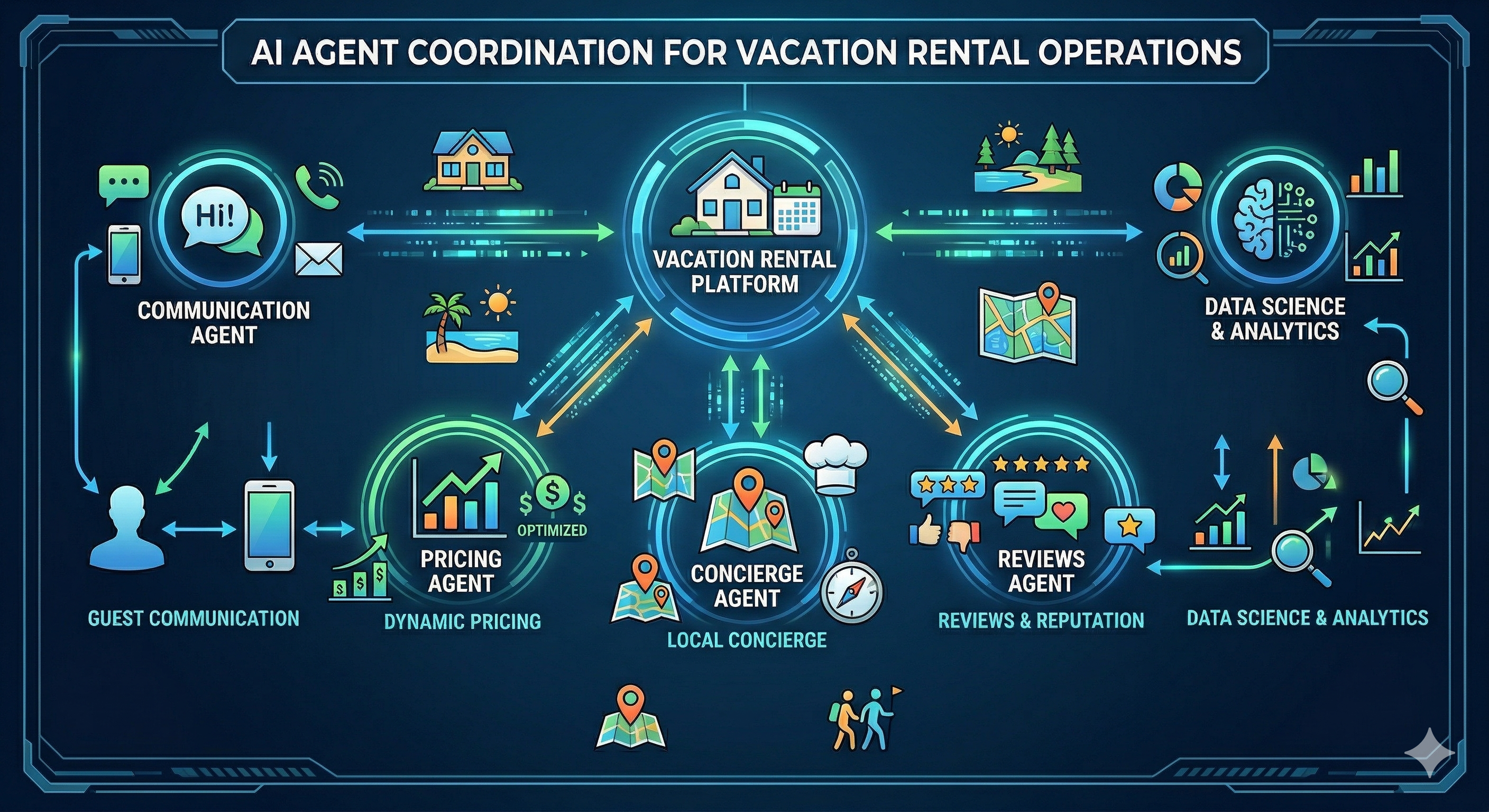
A single agent focuses on one domain (communication, pricing, reviews, etc.). Multiple agents with different specializations working together form a multi-agent system.
The Defining Characteristic of Agents: Agents don’t just follow instructions. They pursue goals. A Communication Agent’s goal is “respond to every guest message appropriately and resolve their issue.” How it does that—through direct response, suggestion routing, escalation, or offering alternatives—depends on context and judgment, not pre-written rules.
The Five Core AI Agents for Vacation Rentals
In 2026, a comprehensive vacation rental operation typically involves five core AI agents, each with a specific domain and function:
Goal: Respond to every guest message (across all channels) appropriately, 24/7
What It Observes: - Incoming messages from Airbnb, Vrbo, Booking.com, WhatsApp, SMS, email, direct booking
- Guest history and previous interactions
- Property status and availability
- Current booking information
- Common guest needs and pain points
What It Decides:
- Can I answer this directly? (WiFi password, parking info, house rules)
- Does this need clarification? (What specifically is the guest asking?)
- Do I need to offer a solution? (Coordinating late checkout, early arrival, special requests)
- Should I escalate? (Complaint, dispute, unusual request)
Actions It Takes:
- Responds with accurate, contextual information
- Makes decisions within authority (offering paid late checkout, for example)
- Coordinates with other agents (asking Operations Agent for turnover feasibility) - Escalates to human with full context pre-loaded
- Learns from patterns (this type of guest needs X information)
Real Example: Guest messages: “Heyyy we’re landing 2 hours early, can we check in early? We have a 4-month-old baby”
Traditional Automation: “Standard check-in is 3 PM. Early check-in available for $75.”
Communication Agent:
- Observes: Guest has baby, arriving early, unclear if they understand schedule
- Context: Property is ready at 2 PM (turnover finished early), no next guest until evening
- Decision: Offer complimentary early check-in (builds loyalty, minimal cost), proactively prepare crib, offer recommendations for family-friendly restaurants nearby
- Action: “Great! We can do early check-in at no extra charge. I’m preparing a crib for your little one. Check-in link will be available at 1 PM. [Personalized family recommendations for the area]”
Autonomy Rate: Handles 80-90% of guest messages completely autonomously
Goal: Maximize revenue while maintaining occupancy targets
What It Observes:
- Historical occupancy patterns and pricing at different rate points
- Competitor rates across all OTAs (in real-time)
- Local events and seasonality
- Booking pace and demand signals
- Property-specific factors (recent reviews, recent pricing changes)
What It Decides:
- What nightly rate maximizes revenue this week? (Balance between price and occupancy)
- Should I adjust rates daily, weekly, or by season?
- What’s the relationship between competitor pricing and our occupancy?
- How should this property’s pricing relate to similar properties in the portfolio?
- When should I accept lower rates for occupancy vs. holding firm for revenue?
Actions It Takes: - Continuously optimizes nightly rates across all OTAs
- Adjusts pricing based on real-time demand signals
- Implements seasonal and event-based pricing strategies
- Tests price sensitivity and learns from results
- Coordinates with other agents (reviews low? Price carefully to rebuild occupancy)
Real Example: Three competitive properties in the same market. Traditional pricing manager might charge all three the same nightly rate.
Pricing Intelligence Agent:
- Property A: Consistently gets better reviews (4.8 stars). Price at premium (+10%)
- Property B: Middle reviews (4.5 stars). Price at baseline
- Property C: Newer, fewer reviews. Price at -5% to drive occupancy and review velocity
- Adjusts continuously based on new reviews, competitor actions, market demand
Revenue Lift: 15-30% increase compared to manual pricing
Goal: Enhance guest experience and increase revenue through strategic recommendations
What It Observes:
- Guest profile (nationality, travel party composition, interests if available)
- Booking details (length of stay, purpose, dates)
- Local options and experiences
- Current availability of premium services (early check-in, late checkout, equipment)
- What upsells have been successful with similar guests
What It Decides:
- What services or experiences would genuinely enhance this guest’s stay?
- What’s the likelihood this guest will accept an upsell offer?
- When should I offer? (Before arrival? At check-in? During stay?)
- How should I frame the offer (premium experience vs. convenience)?
- Should I personalize based on guest profile or be more general?
Actions It Takes:
- Makes personalized recommendations for local experiences
- Offers premium services (early check-in, late checkout, equipment rental) - Suggests amenity additions based on guest needs
- Coordinates with operations for feasibility of upsells
- Learns what recommendations convert and for which guest types
Real Example: Guest booking 1-week stay with spouse, traveling from UK, checking in Friday evening.
Concierge Agent:
- Observes: UK guests, week-long stay, weekend arrival, pattern suggests leisure travel
- Personalizes: Curates local restaurants recommended by other UK visitors, offers sunset tour recommendation for Friday evening
- Upsells: “Would you like to upgrade to late checkout (11 AM) for Sunday—only $40? Gives you extra time to relax before departure.”
- Additional: Offers wine or local craft beer pairing suggestions, coordinates with local wine shop for delivery
Upsell Revenue: 30%+ additional revenue per booking on average
Goal: Maintain and improve reputation by responding to all reviews strategically
What It Observes:
- All reviews across Airbnb, Vrbo, Booking.com, Google, and other platforms
- Review sentiment (positive, neutral, negative, critical)
- Specific issues mentioned (cleanliness, communication, amenities, etc.)
- Response patterns and their impact on host ratings
- Trends in guest feedback
What It Decides:
- Should I respond to this review? (Yes, to all)
- What’s the appropriate tone? (Grateful for positive, empathetic for negative, reassuring for concerns)
- Should I offer compensation or solution? (Only if appropriate and feasible)
- How does this review connect to broader patterns? (Is cleanliness a recurring complaint?)
Actions It Takes:
- Writes personalized response to every review within 24 hours
- Flags reviews with issues for operational follow-up
- Identifies trends (three cleanliness complaints = cleaner needs retraining or replacement)
- Escalates reviews with serious issues (disputes, conflicts, potential liability)
- Learns what response types improve future ratings
Real Example: Negative review: “The WiFi kept dropping throughout our stay. Otherwise, the property is beautiful.”
Traditional Review Response: “Thank you for staying with us. We’re sorry to hear about the WiFi issues. Please let us know if you have any concerns.”
Review Management Agent:
- Observes: WiFi complaint, not catastrophic overall (compliment on property), guest seems reasonable
- Decision: Apologize specifically, offer solution going forward, potentially offer makeup night or discount
- Response: “We’re truly sorry the WiFi wasn’t reliable during your stay—we know how frustrating that is. We’ve since upgraded our router and tested with multiple devices. We’d love to make it right. Would a $50 credit toward a future stay work for you?”
- Follow-up: Escalates to IT to verify WiFi issue resolved, adds note to check WiFi quality during next turnover
Response Rate & Impact: 100% response rate (vs. 40-60% manual), correlates with 0.3-0.5 star rating improvement over time
Goal: Identify patterns, predict outcomes, and recommend optimizations
What It Observes:
- All operational data (bookings, pricing, occupancy, reviews, revenue, costs)
- Guest feedback patterns and sentiment
- Operational metrics (turnover time, maintenance frequency, cleaning issues)
- Market trends and competitive landscape
What It Decides:
- What patterns are meaningful vs. noise?
- What’s driving occupancy? Pricing? Reviews? Seasonality?
- What optimizations would have the highest impact?
- Which properties are underperforming and why?
- What’s the correlation between different variables? (Does higher pricing affect reviews? Does response time affect repeat bookings?)
Actions It Takes:
- Generates insights and recommendations
- Identifies anomalies (one property suddenly underperforming)
- Forecasts occupancy and revenue trends
- Suggests operational improvements with projected impact
- Provides transparency into why the other agents are making decisions
Real Example: Data analysis shows: Properties with 100% review response rate have 22% higher repeat booking rate than properties with 60% response rate.
Data Scientist Agent:
- Quantifies the value: Each additional review response is worth ~$150 in incremental repeat booking revenue
- Recommends: Prioritize 100% review response rate above all else (drives other agent decisions)
- Identifies opportunity: One property at 40% response rate is dragging down overall performance
- Recommends: Implement review management automation on that property specifically
How Agents Work Together: The Multi-Agent System
The real power isn’t in individual agents—it’s in how they coordinate as a system.
Scenario: Guest books property, arrives early, has special request
- Communication Agent receives early arrival request. Checks property status. Property will be ready at 1 PM (turnover finishes at 1 PM). Coordinates with Operations Agent: “Can we confirm early check-in at 1 PM?”
- Operations Agent verifies: Cleaner confirmed for 1 PM, next guest check-in isn’t until 3 PM in a different property. Confirms: “Early check-in at 1 PM is confirmed”
- Communication Agent (back to guest): “Approved! Check-in available at 1 PM” (immediate response, guest never waits)
- Concierge Agent observes: Guest arriving 2 hours early, likely excited to settle in. Offers “local recommendations” and “early check-in drink option” (wine from local shop)
- Pricing Intelligence Agent observes: This booking is performing well in terms of occupancy. Slight increase in similar bookings indicates higher demand. Consider raising rates for next month in this market segment.
- Review Management Agent prepares: Knowing this guest requested early arrival and will receive personalized concierge, sets positive expectations for future review response.
All of this coordination happens in minutes. No human needed to manage the back-and-forth. Guest gets immediate response. Property runs smoothly.
Agent Autonomy vs. Human Control
An important distinction: AI agents operate with clear constraints and escalation rules.
An agent doesn’t have unlimited authority. For example:
Communication Agent autonomy:
- Respond to standard questions: ✅ Full authority
- Offer paid add-ons (late checkout): ✅ Full authority
- Offer free upgrades or compensation under $50: ⚠️ Escalate to manager if outside normal parameters
- Agree to guest’s request to discount rate by 30%: ❌ Escalate to manager
- Discuss property damage claims: ❌ Escalate immediately to manager
Pricing Agent autonomy:
- Adjust nightly rates within market conditions: ✅ Full authority
- Increase base rates by 50% based on one excellent review: ❌ Escalate (potential outlier)
- Price strategy that prioritizes occupancy over revenue: ✅ Follow manager’s strategy choice
- Radical pricing changes (double the nightly rate): ⚠️ Alert manager to changes exceeding threshold
You (the property manager) set the guardrails. The agents operate within those guardrails with full authority. Anything outside the guardrails gets escalated to you with full context.
Why Agents Matter Right Now
In 2026, 84% of property managers use AI in their workflows (2026 Industry report). But not all AI is equal.
-
Rule-Based Automation: Still works, but limited
-
Machine Learning Systems: Better pattern recognition, but still passive
-
AI Agents: Proactive, adaptive, learning, coordinated
Property managers who’ve adopted agent-based systems report:
- 12.5 hours/week → 1 hour/week management time per property
- 15-30% revenue increase through coordinated pricing, communication, and upsells
- 4.8-star average reviews through 100% review response rates
- 30% of active users operate in fully autonomous mode
The difference isn’t incremental. It’s fundamental.
FAQ
Q1: Isn’t an AI agent just a chatbot with a fancy name?
A: No. A chatbot responds to inputs. An agent observes situations, makes decisions, takes actions, coordinates with other agents, and learns. A chatbot is reactive; an agent is proactive and adaptive. The difference is like the difference between a vending machine (chatbot) and a concierge (agent).
Q2: Do agents make mistakes? What happens when an agent decides wrong?
A: Yes, agents can misjudge situations, which is why they have escalation protocols. If a Communication Agent isn’t confident in its response, it escalates to you. If a Pricing Agent wants to make a change outside normal parameters, it alerts you. The system is designed to fail safe—escalating uncertainty rather than acting on it.
Q3: If I have five agents, isn’t that overly complex?
A: Counter-intuitive: having agents with clear specializations is simpler than trying to run everything through one system. The Communication Agent focuses on communication excellence. The Pricing Agent focuses on revenue optimization. Each is expert in its domain. They coordinate automatically. The complexity is internal; what you experience is simplicity.
Q4: Can agents work together without human involvement?
A: For most scenarios, yes. Example: Guest requests early check-in → Communication Agent asks Operations Agent for feasibility → Operations Agent coordinates with cleaner → Communication Agent confirms with guest. Zero human involvement, but coordination happens. Humans only engage for escalations or strategic decisions.
Q5: Are agents replacing property managers?
A: No. Agents are replacing the repetitive operational work. They free up time for property managers to focus on strategy, relationships, portfolio growth, and high-value decisions. About 30% of active users delegate operational decisions to agents (autonomous mode). 70% maintain oversight but dramatically reduce time spent. The manager’s role is evolving, not disappearing.
Ready to Meet Your AI Agents?
Understanding what AI agents are is one thing. Seeing them work in your business is transformative.
Jurny’s Network of Intelligent Agents (NIA) brings together five specialized agents working in coordination: Communication, Pricing Intelligence, Concierge & Upsell, Review Management, and Data Science. See how they’d operate on your properties.
Explore Jurny: