Quick Answer: By 2027, agentic AI systems capable of autonomous multi-step decision-making are expected to reach mainstream deployment in property management. The operators who understand what's coming — and build toward it now — will have a significant structural advantage over those reacting to the shift after it happens.
The short-term rental industry has changed more in the last two years than in the previous decade. AI went from a marketing term to an operational reality. The platforms that were experimental in 2023 are now running the daily operations of thousands of portfolios. The percentage of property management companies using AI tools jumped from 20% to 58% in a single year.
That rate of change isn't slowing. If anything, it's accelerating — driven by improvements in AI reasoning, the emergence of agentic systems, and the economic pressure on operators to squeeze more performance from the same number of properties.
Here's a clear-eyed look at where the industry stands now, what will be automated by 2027, and what will still require human judgment even as the technology matures.
Where We Are Now (2026): The Automation Baseline
In 2026, the most capable AI-native property management platforms handle:
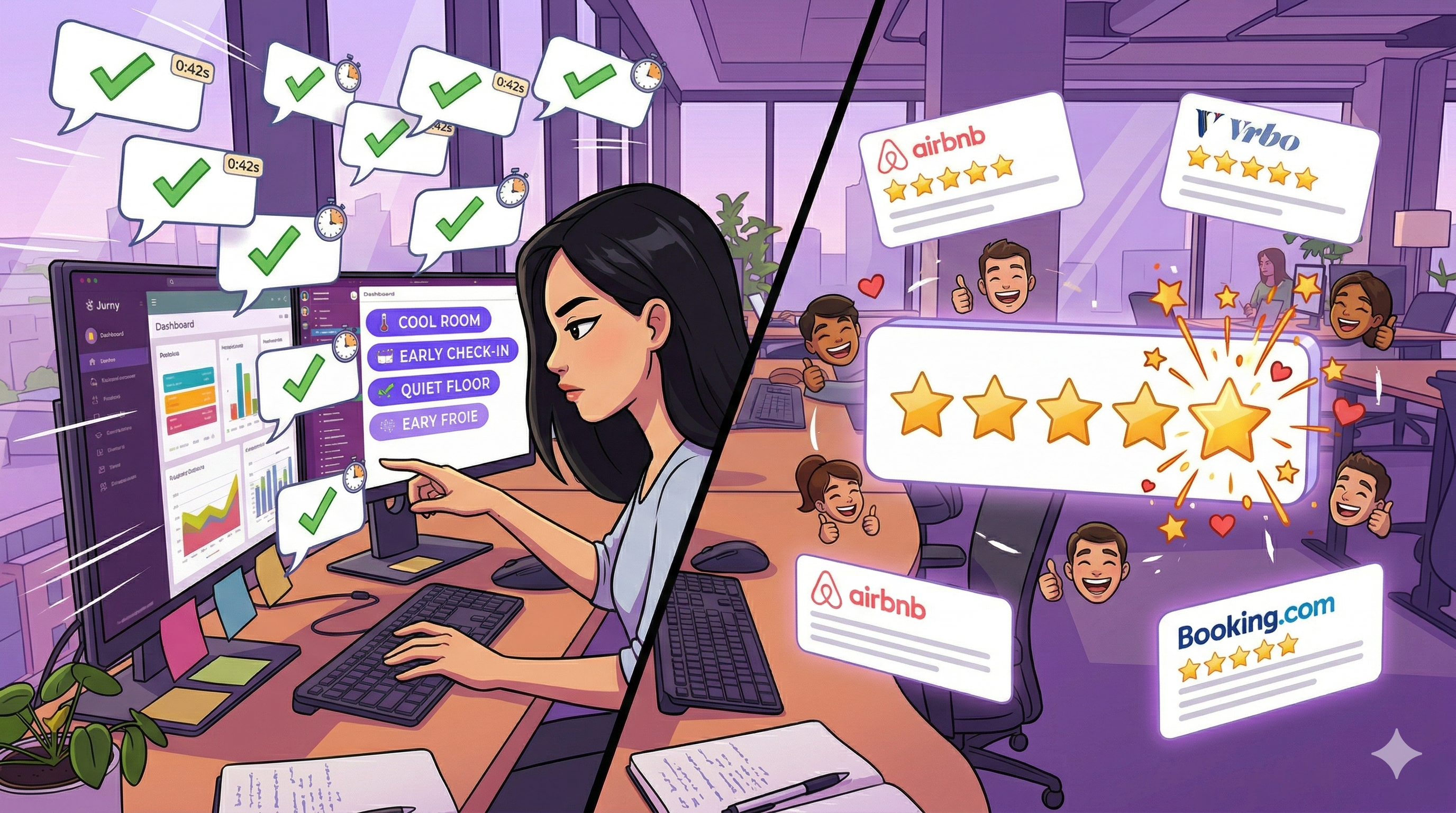
- Guest communication: 70–90% of inbound messages resolved autonomously, across all channels, in under 60 seconds
- Dynamic pricing: continuous rate adjustment based on real-time market signals — competitor rates, booking velocity, local events, seasonal demand
- Operational triggers: cleaning scheduling, access code management, and maintenance task creation firing automatically from booking events
- Upsell automation: timed offers for early check-in, late checkout, and experience add-ons, delivered without manual initiation
- Review management: post-stay review requests timed to the optimal window, with AI-generated personalized messaging
This is the current state of the art. It represents a significant operational advantage for operators who've implemented it, and a widening gap against those who haven't.
What Changes by 2027: Agentic AI Enters the Operation
The next phase isn't an incremental improvement on current automation. It's a categorical shift: from AI that responds to inputs to AI that initiates multi-step actions autonomously.
Agentic AI systems are expected to reach mainstream use between 2026 and 2027, enabling largely automated property management operations, according to real estate industry analysis. Morgan Stanley estimates AI will deliver approximately $34 billion in efficiency gains to the real estate industry over the next five years. These aren't marginal improvements — they reflect a fundamentally different operational model.
Here's what agentic AI enables that current automation can't:
Proactive Issue Resolution (Not Just Response)
Current AI responds to messages. Agentic AI detects patterns that signal a problem is coming and acts before the guest notices. An HVAC unit showing anomalous sensor readings triggers a maintenance ticket and a vendor assignment before a guest complains about a hot room. A booking pattern suggests a guest is likely to have a late arrival — the AI sends a proactive message and pre-adjusts the access window. Prevention rather than reaction.
Autonomous Revenue Management Decisions
Current dynamic pricing tools adjust rates based on rules and market data. Agentic pricing AI will make compound decisions: detecting a high-demand weekend three weeks out, proactively reaching out to previous guests with a first-access early booking opportunity, then adjusting minimum stay requirements based on how the booking window fills. The decisions compound across multiple variables simultaneously, not sequentially.
Predictive Maintenance Before Failure
Predictive maintenance AI analyzes sensor data from appliances, HVAC systems, and smart home devices to identify patterns that precede failures. Predictive maintenance reduces equipment downtime by up to 22% compared to reactive maintenance, according to industry data. By 2027, integration between IoT sensor networks and property management AI will enable this capability at scale — not as a standalone system, but as part of the operational layer that runs the portfolio.
Personalized Guest Journeys at Scale
By 2027, AI systems will use guest history — preferences from past stays, communication patterns, upsell response behavior — to personalize every touchpoint of the guest journey. A returning guest gets a welcome back message that acknowledges their preferences. Room temperature settings adjust automatically based on their last stay. Upsell recommendations reflect what they've responded to before. Personalization that currently requires a boutique hotel's attentive staff becomes automated and scalable.
Portfolio Intelligence and Proactive Owner Communication
Agentic AI will monitor portfolio performance continuously and surface insights before owners ask. Underperforming properties get flagged with specific root cause analysis and recommended actions. Owner reports generate automatically with narrative context — not just raw data, but interpretation of what the data means and what should be done about it. Owner relationships shift from reactive reporting to proactive strategic partnership.
What Will Still Require Humans in 2027
The AI trajectory is significant — but honesty about its limits is important.
Physical presence: Maintenance execution, property inspections, cleaning quality control, and any situation requiring someone to actually be at a property will still need a human. AI can coordinate and optimize this work, but it cannot do it.
Complex relationship management: Owner negotiations, dispute resolution with guests where legal exposure is possible, and high-stakes decisions that require accountability will still benefit from human judgment and ownership.
Local market knowledge: Understanding what makes a specific neighborhood unique, building relationships with local vendors, and making judgment calls about property positioning in a hyper-local context are areas where human expertise adds irreplaceable value.
Strategic decisions: What markets to enter, when to expand the portfolio, how to position the business for acquisition — these decisions benefit from AI-sourced data, but the judgment layer remains human.
What This Means for Operators Making Decisions Today
The operators who will have the strongest position in 2027 are the ones building toward agentic AI capability now — not by waiting for the technology to arrive, but by building the infrastructure that makes adoption seamless when it does.
That means: choosing an AI-native platform with a strong R&D roadmap rather than a legacy platform adding AI features as afterthoughts. It means standardizing property infrastructure so that AI systems can learn and adapt across consistent data. It means building the direct booking channel and guest data assets that will power personalization at scale.
The companies managing vacation rentals in 2027 will look fundamentally different from the ones managing them manually today. The gap is already opening. The operators who act now are the ones on the right side of it.
How Jurny Is Built for What's Coming
Jurny's AI-native architecture, built around the NIA engine, is designed to evolve toward agentic capability — not as a future add-on, but as the natural extension of a platform where AI already handles the full operational layer. For operators who want to build toward the 2027 standard without switching platforms when the technology arrives, Jurny is designed to be that foundation.
Frequently Asked Questions
What is agentic AI in property management?
Agentic AI refers to systems that don't just respond to inputs but initiate multi-step actions autonomously based on perceived conditions. In property management, this means an AI that detects a maintenance risk and coordinates the repair without being prompted, or identifies a revenue opportunity and executes a multi-channel strategy to capture it — all without human initiation.
When will agentic AI become mainstream in short-term rental management?
Industry analysis projects that agentic AI systems will reach mainstream use in real estate and property management between 2026 and 2027. Leading platforms are already in pilot deployment. The question for operators is not whether this transition will happen, but whether they'll be positioned to benefit from it when it does.
Will AI replace property managers by 2027?
No. AI will continue to automate the high-volume, repetitive, and coordination-heavy tasks that currently consume most of a property manager's time. What remains — owner relationships, physical operations, strategic decisions, and complex guest situations — is work that benefits from human judgment. The role of property manager evolves from operational executor to strategic overseer.
What is predictive maintenance in vacation rentals?
Predictive maintenance uses IoT sensors and AI analysis to detect patterns in property systems — HVAC, appliances, plumbing — that indicate impending failures. Instead of reacting to a broken air conditioner mid-summer, the system flags the issue weeks in advance and schedules a preventive repair. This reduces emergency repair costs, minimizes guest impact, and extends equipment lifespan.
How should I prepare my STR operation for the future of AI automation?
Three things: standardize your property infrastructure (consistent smart lock hardware, consistent data inputs), choose an AI-native platform with a genuine R&D roadmap (not a traditional PMS adding AI features), and build your guest data assets now (direct booking channel, email capture, guest history tracking). These create the foundation that agentic AI systems will run on.
Build for Where the Industry Is Going
Jurny is designed to grow with the AI curve — not require you to switch platforms every time the technology advances. Book a demo today! →
Explore Jurny: