
The average AI guest messaging tool in the short-term rental industry resolves well below what is actually achievable of guest inquiries automatically. The rest go to a human.
At first glance, that sounds impressive. But do the math at scale. If you manage 30 properties averaging four guest messages per day per property, you are looking at 120 messages daily. At a typical automation rate, 48 of those still require a human response. At a 98 percent rate, that drops to fewer than three.
The difference between 48 manual responses and six is not a feature. It is an operational paradigm. And it comes down to one thing: the data your AI has access to when a guest sends a message.
Why Suboptimal Automation Is the Default — Not the Ceiling
Most AI messaging tools in the STR market are built as standalone products. They connect to your PMS via API to pull basic reservation data — guest name, check-in and check-out dates, the property address. That is the extent of their context.
When a guest sends a message asking whether they can check in two hours early, the AI checks the reservation. It sees the standard check-in time. It does not know whether the previous guest has already checked out. It does not know whether cleaning has been completed or is still in progress. It does not know whether the property was flagged for a maintenance issue earlier that morning.
So it does what it was built to do with incomplete information: it escalates. A human picks up the thread, checks the cleaning app, checks the maintenance log, determines that yes, the property is actually ready, and sends a response. The AI was capable of sending that same response. It just did not have the data to do it confidently.
This is the data gap problem. It is not a capability gap. It is a data gap.
The 5 Pieces of Data Your AI Needs to Hit 98 Percent
Reaching 98 percent automation is not about a smarter AI model. It is about giving your AI access to the right information at the moment a guest message arrives. Here is what that looks like in practice.
1. Real-Time Room Status
Your AI needs to know whether a property is occupied, in turnover, cleaning in progress, or ready — updated in real time, not pulled from a scheduled sync. When a guest asks about early check-in or a late checkout, the answer depends entirely on the current state of the property. Without real-time room status, your AI cannot give an accurate answer.
2. Cleaning Schedule and Completion Status
Connected to room status but distinct from it. Your AI needs to know not just that cleaning is scheduled but where it stands. Has the cleaner checked in? Is the property expected to be ready in 30 minutes or two hours? This information changes the answer to the guest's question entirely.
3. Access Codes and Check-In Procedures
This seems obvious, but many AI tools do not have access to property-level access codes and check-in procedures. They either do not connect to smart lock systems or rely on static information that may not reflect the most recent code rotation. When a guest cannot get in, they send a message. If your AI cannot look up the current access code for that specific property, a human steps in every single time.
4. Guest History Across All Properties
Returning guests expect to be recognized. If a guest stayed at one of your properties six months ago and is now booking a different one, and your AI treats them as a first-time guest, that is a missed opportunity at best and a minor insult at worst. Beyond personalization, guest history helps your AI understand preferences, flag potential issues, and tailor upsell offers. None of this is possible without a centralized guest record.
5. Property-Specific Policies and SOPs
Every property has nuances — noise policies, parking instructions, pet rules, house rules, check-in procedures that differ from the default. When your AI answers from a generic knowledge base rather than property-specific documentation, it gives answers that are wrong often enough to erode guest trust and generate escalations that humans then have to clean up.
How to Audit Your Current AI Tool
If you are using an AI messaging tool and wondering whether your data gap is holding back your automation rate, here are the questions to ask your vendor.
- Does your AI have access to real-time room status, or does it sync on a schedule?
- Can your AI see cleaning completion status from your housekeeping system?
- Does your AI have access to current access codes for each property?
- Can your AI see a guest's full booking history across all properties in my portfolio?
- Are property-specific policies and SOPs fed into the AI's context, or is it working from generic templates?
If the answer to any of these is no or it depends on your integrations, you have found your ceiling. Your AI is not failing to resolve those messages because it is not smart enough. It is failing because it does not have what it needs to succeed.
What 98 percent automation Actually Looks Like
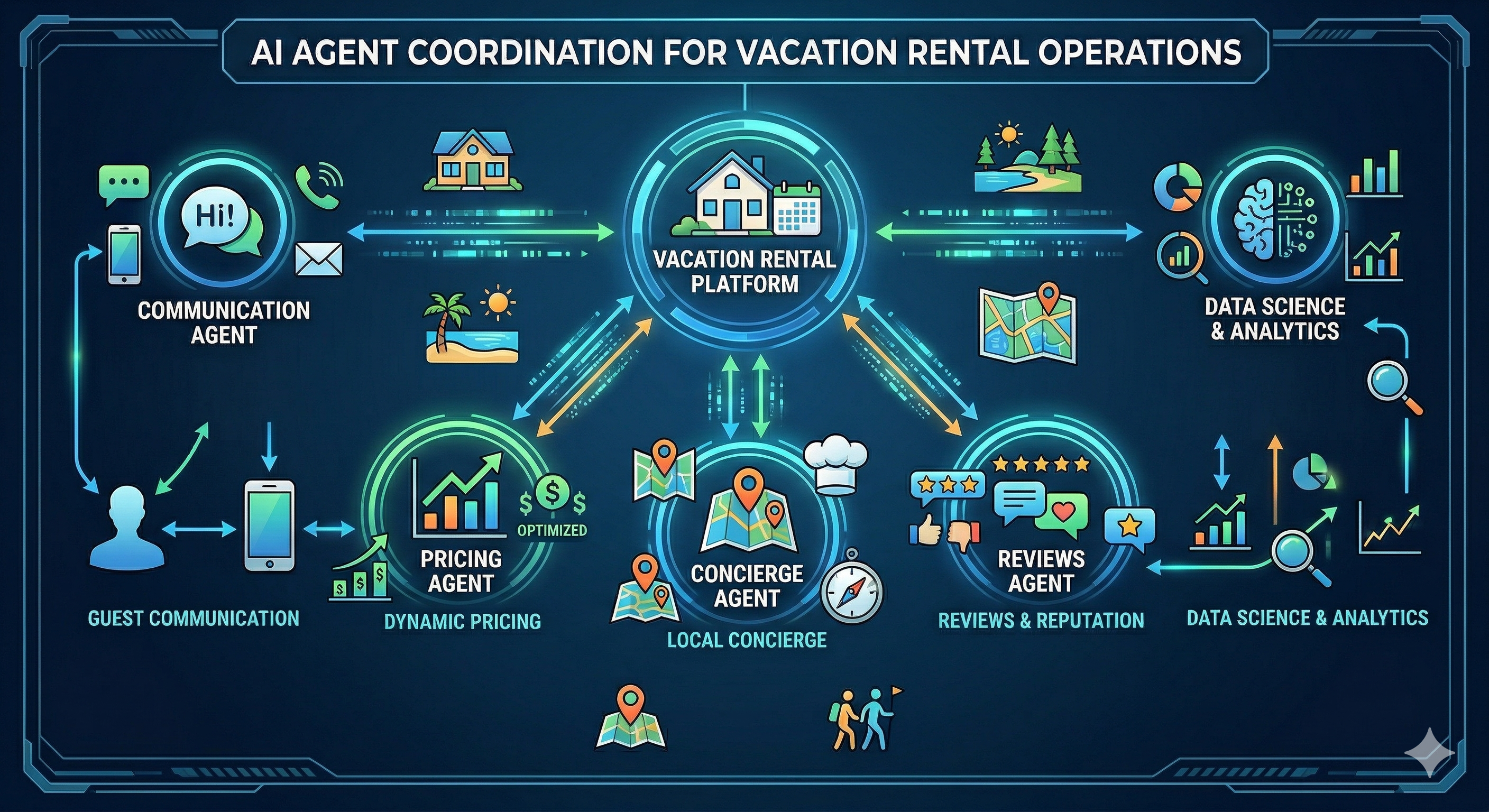
Operators running at 98 percent or higher automation rates are not running a fundamentally different AI model. They are running an AI system that has full context — one where the messaging layer, the PMS, the housekeeping system, the access control system, and the guest CRM are not separate products sharing data through fragile API connections, but parts of a single platform sharing a single data layer.
When a guest messages asking whether they can bring their dog, the AI checks the property-specific pet policy, not a generic house rules template. When a guest asks about parking, the AI pulls the parking instructions specific to that property, not a default answer. When a guest reports a broken air conditioner, the AI creates a maintenance ticket, notifies the relevant team, and responds to the guest with an accurate timeline — without a human ever seeing the original message.
Inside Jurny, NIA — Jurny's network of intelligent agents — operates from a complete, real-time picture of your operation. Every property, every guest, every reservation, every cleaning status, every access code, every policy. The result is not a higher automation rate as a vanity metric. It is a fundamentally different operating model, where your team's attention goes to the six messages that genuinely need a human — not the forty-eight that did not.
The Question Worth Asking
If your AI messaging tool is resolving 60 percent of messages, the question is not whether to live with that number. The question is how much time and money you are spending on the 40 percent it cannot handle — and whether that is a function of your AI's capabilities or the data you are giving it to work with.
In most cases, it is the latter. And the fix is not a new AI model. It is a new architecture.
Book a demo with Jurny to see what 98 percent automation looks like for your portfolio size.
Explore Jurny:


.jpg)