
Every major wave of technology has a moment where the infrastructure clicks into place — when the pieces that were always theoretically possible suddenly work together in practice. For AI in property management, that moment is MCP.
The Model Context Protocol is not a product. It's not a feature. It's the connective tissue that turns isolated AI tools into an integrated intelligence layer across your entire operation. And for short-term rental operators managing 15+ properties, it changes everything about what's possible.
The Problem MCP Solves: AI That Doesn't Know Your Business
You've probably experimented with AI tools. ChatGPT for writing guest messages. Maybe a chatbot plugin for your website. Perhaps an automated pricing suggestion somewhere in your stack.
And you've probably noticed the same problem every time: the AI doesn't actually know your business. It gives generic answers. It can't see your bookings. It doesn't know which property has a maintenance issue or which guest left last week without paying for a broken appliance.
This is the fundamental limitation of AI without context — and it's the exact problem that MCP (Model Context Protocol) was built to solve.
MCP creates a live, secure connection between an AI model and your actual operational data. When Claude connects to your Jurny MCP Server, it doesn't just know about property management in general — it knows your properties, your guests, your revenue, and your operational status. Right now. In real time.
What MCP-Connected AI Actually Looks Like for STR Operators
Stop thinking about AI as a writing tool. With MCP, AI becomes an operational co-pilot. Here's what that looks like for a 30-unit portfolio manager on a typical Tuesday morning:
Without MCP:
Open five different dashboards. Cross-reference occupancy data manually. Guess at which listings need attention. Spend 90 minutes compiling a weekly report that's already out of date by the time you share it.
With MCP-connected AI:
Open Claude. Ask: "What do I need to focus on today?" Get a prioritized briefing — properties with upcoming check-ins that haven't been cleaned, listings with declining click-through rates, guest messages that need urgent attention, and pricing gaps for the next holiday weekend. In 60 seconds.
That's not science fiction. That's what Jurny's NIA AI agents connected via MCP deliver to operators right now.
The 5 Operational Superpowers MCP Unlocks
1. Real-Time Portfolio Intelligence
Query your entire portfolio in plain English. "Which properties are underperforming vs. market rate?" "What's my average response time this week?" "Which guest had the highest lifetime value?" MCP-connected AI answers instantly, pulling from live data across your revenue management and booking history.
2. Proactive Issue Detection
Instead of waiting for problems to surface, MCP-connected AI scans your operational data continuously and flags anomalies before they become crises. A listing suddenly getting fewer views. A guest who hasn't received check-in instructions. A cleaning assignment that wasn't confirmed. All caught automatically.
3. Intelligent Guest Communication
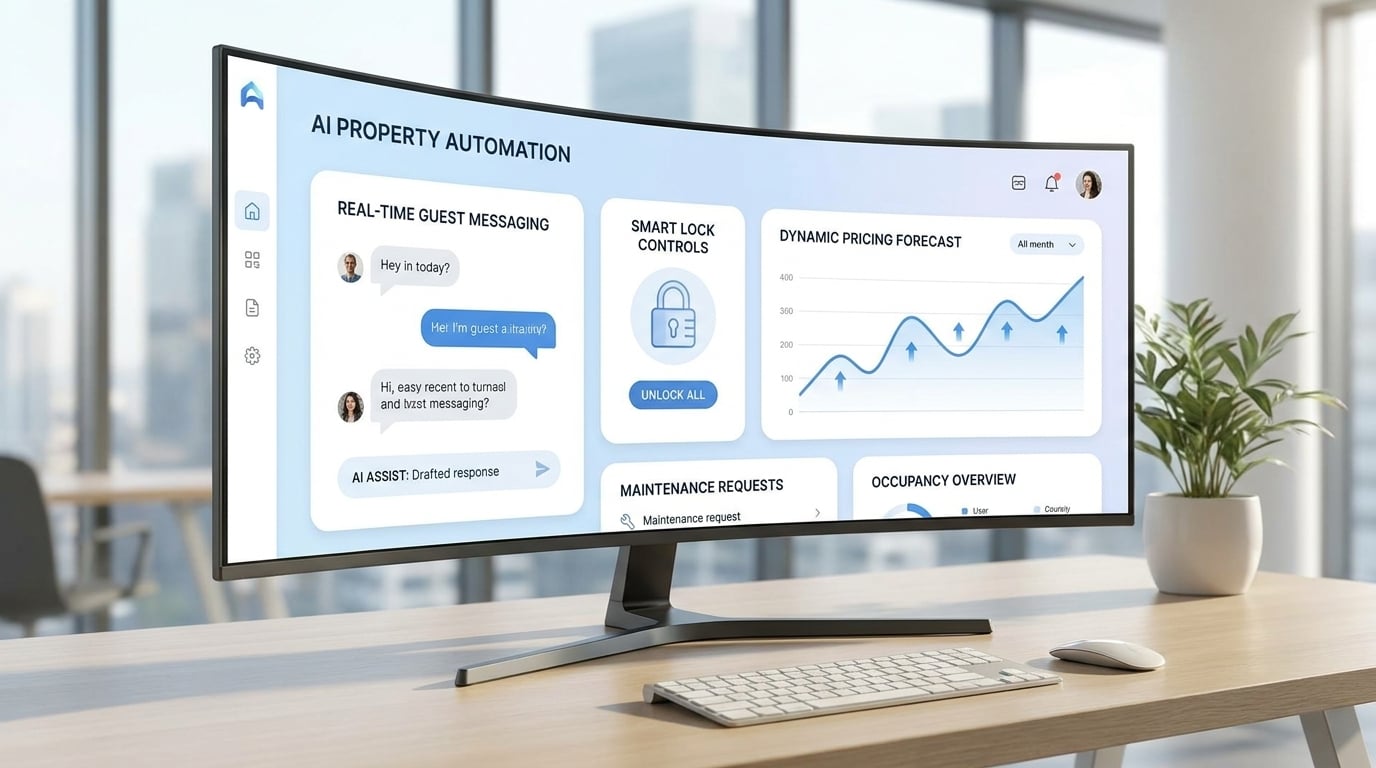
Your Unified AI Inbox already handles automated responses — but MCP takes it further. When a guest asks about their specific reservation, MCP-connected AI can pull the actual booking details, cross-reference the property guide, and craft a response that's accurate to their exact stay. Not a template. An intelligent, contextual reply.
4. Cross-Portfolio Analysis on Demand
Compare performance across properties, markets, or time periods without building a single spreadsheet. MCP lets you ask comparative questions — "Which of my beach properties outperformed last summer vs. this summer, and why?" — and get data-backed answers that would take a data analyst hours to compile.
5. Action, Not Just Insight
The most important distinction between MCP-connected AI and a dashboard: MCP doesn't just show you data, it helps you act on it. Draft the message. Flag the listing. Trigger the workflow. The gap between insight and action collapses entirely.
Why MCP Is the Future of Property Management Software
The property management software industry is in the middle of a massive consolidation — not of companies, but of capabilities. The operators who win in the next three years won't necessarily be the ones with the most tools. They'll be the ones whose tools talk to each other intelligently.
MCP is the protocol that makes that possible. It's why Jurny built its MCP Server as a core product feature — not an add-on, not a beta experiment, but a fundamental part of how the platform delivers intelligence to operators.
Every competitor is adding AI features right now. But there's a difference between adding AI to a PMS and building a PMS that is AI-native from the ground up — with MCP as the connection layer that ties everything together.
That difference is Jurny.
Frequently Asked Questions
What makes MCP different from a regular API integration?
Traditional API integrations are rigid — they move specific data between specific systems for specific purposes. MCP is flexible and intelligent. It gives an AI model the ability to explore, reason, and act across your entire data environment, combining information from multiple sources to answer questions and execute tasks that no pre-built integration could anticipate.
Is MCP secure for property management data?
Yes. Jurny's MCP Server uses secure, authenticated connections and never exposes raw data to third parties. The AI model accesses only what it needs to answer your query, and all connections are encrypted and permission-controlled.
Which AI models work with Jurny's MCP Server?
Jurny's MCP Server is currently optimized for Claude (by Anthropic), which offers the most sophisticated reasoning capabilities for complex operational queries. Additional AI model integrations are on the Jurny roadmap.
The Operators Building on MCP Today Are 12 Months Ahead
Infrastructure advantages compound. The operators who connected their portfolios to Jurny's AI-native OS and MCP server today aren't just more efficient right now — they're building operational intelligence that gets smarter every week. That gap widens over time, not shrinks.
If you're managing 15+ properties and you're ready to stop running your portfolio and start letting your portfolio run itself — this is where it starts.
Explore Jurny: