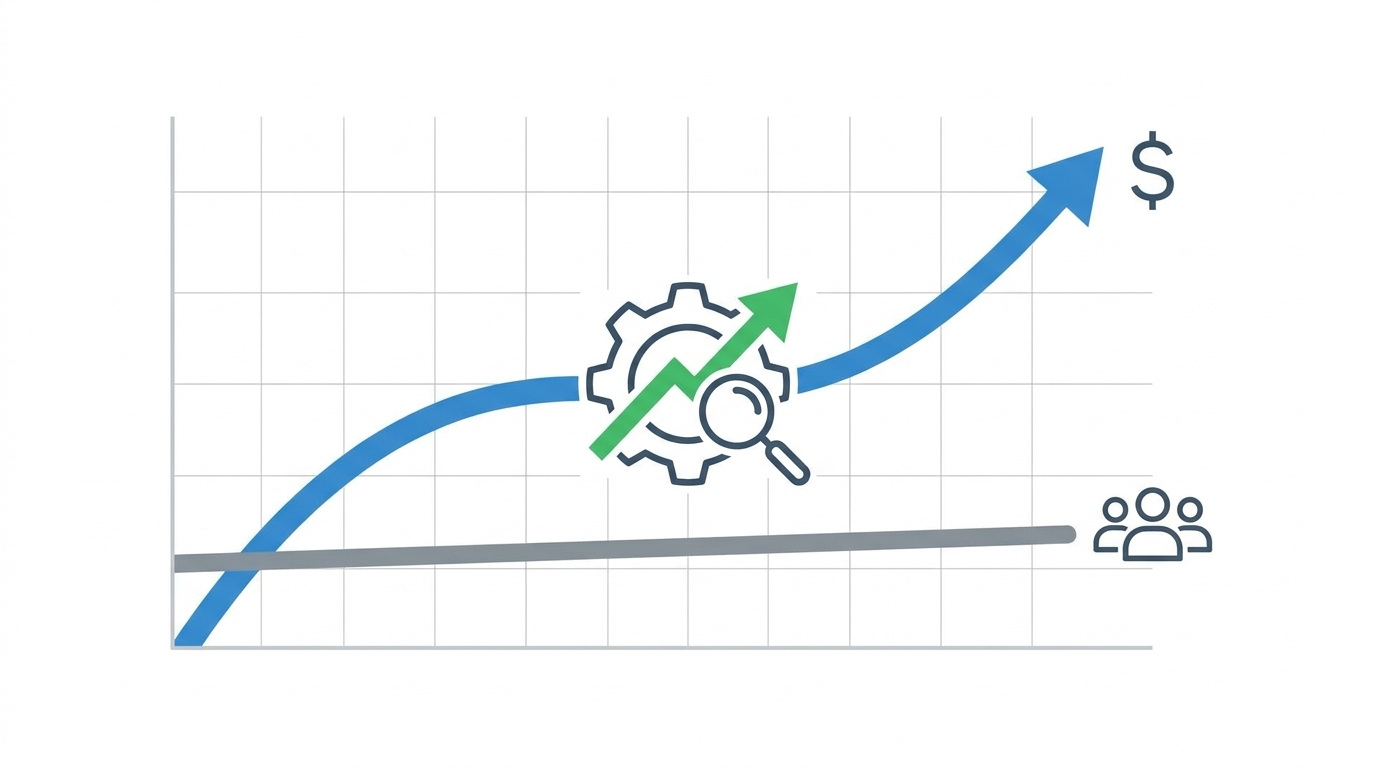
The traditional model of scaling a short-term rental business looks like this: add properties, add staff, manage the ratio. One operations person per ten to fifteen properties. One guest communications manager per twenty. One maintenance coordinator per thirty. The revenue grows, but so does the payroll — and at a certain portfolio size, the margins start to compress in ways that were not anticipated when the business was smaller.
The operators who have broken out of this model are not working harder than you. They have built a different ratio. Not one person per ten properties — one person per forty or fifty. The difference is not hustle. It is infrastructure.
Why the Traditional Scaling Model Breaks
The staffing ratios that most STR operators work toward are derived from a specific assumption: that most operational work requires human time. Guest messages require human responses. Cleaning coordination requires human follow-up. Pricing requires human review. Review responses require human writing.
This assumption was accurate five years ago. It is no longer accurate for operators who have built their operations on AI-native infrastructure. The work that defined those staffing ratios is now either automated entirely or reduced to exception handling — a fundamentally different demand on human time.
Operators still scaling to the traditional ratios are doing so because they are building on the old assumption. The infrastructure exists to support a fundamentally different model. The question is whether they know it and whether they have built for it.
The Revenue Levers That Scale Without Headcount
AI-Driven Guest Communication
The most time-intensive operational function in most STR businesses is guest communication. At scale, it is also the easiest to automate without quality loss — if the automation has access to the right data.
Jurny operators achieve 98 percent guest communication automation. At fifty properties averaging four messages per day, that means fewer than four messages per day require human attention. A team that previously needed two people managing guest communications for twenty-five properties now needs a fraction of a person's time for fifty — and the guest experience is measurably better because NIA responds in seconds, not minutes or hours.
Automated Operations Workflows
Cleaning coordination, maintenance escalation, check-in instruction delivery, turnover confirmation — these are the operational workflows that consume significant team time at scale. Each one follows a predictable pattern. Each one can be automated. Each one, when automated reliably, removes a category of work from your team's plate without removing the outcome from your guests' experience.
Personalized Upsell Revenue
Upsell revenue is one of the cleanest examples of scaling revenue without scaling headcount. At thirty properties with fifty bookings per month each, there are 1,500 monthly upsell opportunities. Delivering personalized offers to each of those guests — at the right moment, based on who they are and what is available — requires either a dedicated team member or an automated system.
NIA's upsell engine delivers those 1,500 personalized offers automatically. The incremental revenue — at 30 percent average conversion on a $55 average offer — is $24,750 per month. The incremental staffing cost is zero.
Dynamic Revenue Optimization
Pricing decisions made manually at large portfolio sizes are always lagging — you are reacting to demand signals that automated systems would have anticipated. Dynamic pricing connected to real-time demand data executes rate changes at the speed the market requires, not the speed your team can process. The revenue improvement from this — typically 15 to 25 percent improvement in revenue per available night — compounds across every property in the portfolio every month.
The Headcount Question
Operators who have scaled to thirty or more properties on AI-native infrastructure describe their teams the same way: smaller than anyone would expect, and focused on decisions that require human judgment rather than tasks that required human execution.
The team does not manage messages — NIA does. The team does not coordinate cleanings — NIA does. The team does not write review responses — NIA does. The team handles the escalations NIA flags, makes decisions about pricing strategy and portfolio expansion, manages vendor relationships, and ensures quality standards are maintained across the portfolio.
This is not a smaller team doing more work. It is a team doing different work — the work that actually requires humans — while the AI handles everything that does not.
What This Means for Growth
The traditional scaling model creates a constraint on growth: every new property requires a proportional increase in operational overhead. At some portfolio size, that overhead makes the next acquisition less attractive — the margin contribution of the new property is partially absorbed by the cost of servicing it.
The AI-native scaling model changes this constraint fundamentally. The marginal cost of adding a property — in operational overhead — approaches zero as the portfolio grows, because the systems handling the operations scale automatically. A fiftieth property costs almost nothing to support operationally beyond the direct costs of the property itself.
This is why the operators building the largest STR portfolios in 2026 are building on AI-native infrastructure. Not because it is exciting technology — because it changes the economics of growth in a way that traditional operational models cannot.
Inside Jurny, the infrastructure that enables this model is built into the platform. Book a demo to see what your growth trajectory looks like when the operational overhead does not scale with the portfolio.
Explore Jurny: