You’ve probably heard the term thrown around in property management circles: “multi-agent AI system,” “intelligent agents,” “NIA 3.0.” But what does any of it mean in practical terms?
Most property managers just want their problems solved. They don’t care about the technology architecture. But understanding how NIA works—Jurny’s Network of Intelligent Agents—actually matters for one reason: architecture determines results.
A property management system with one AI bot trying to do everything will perform okay at most things and poorly at some. A system with specialized, coordinated agents will perform excellently at each function. The difference shows up in guest satisfaction, revenue optimization, and operational efficiency.
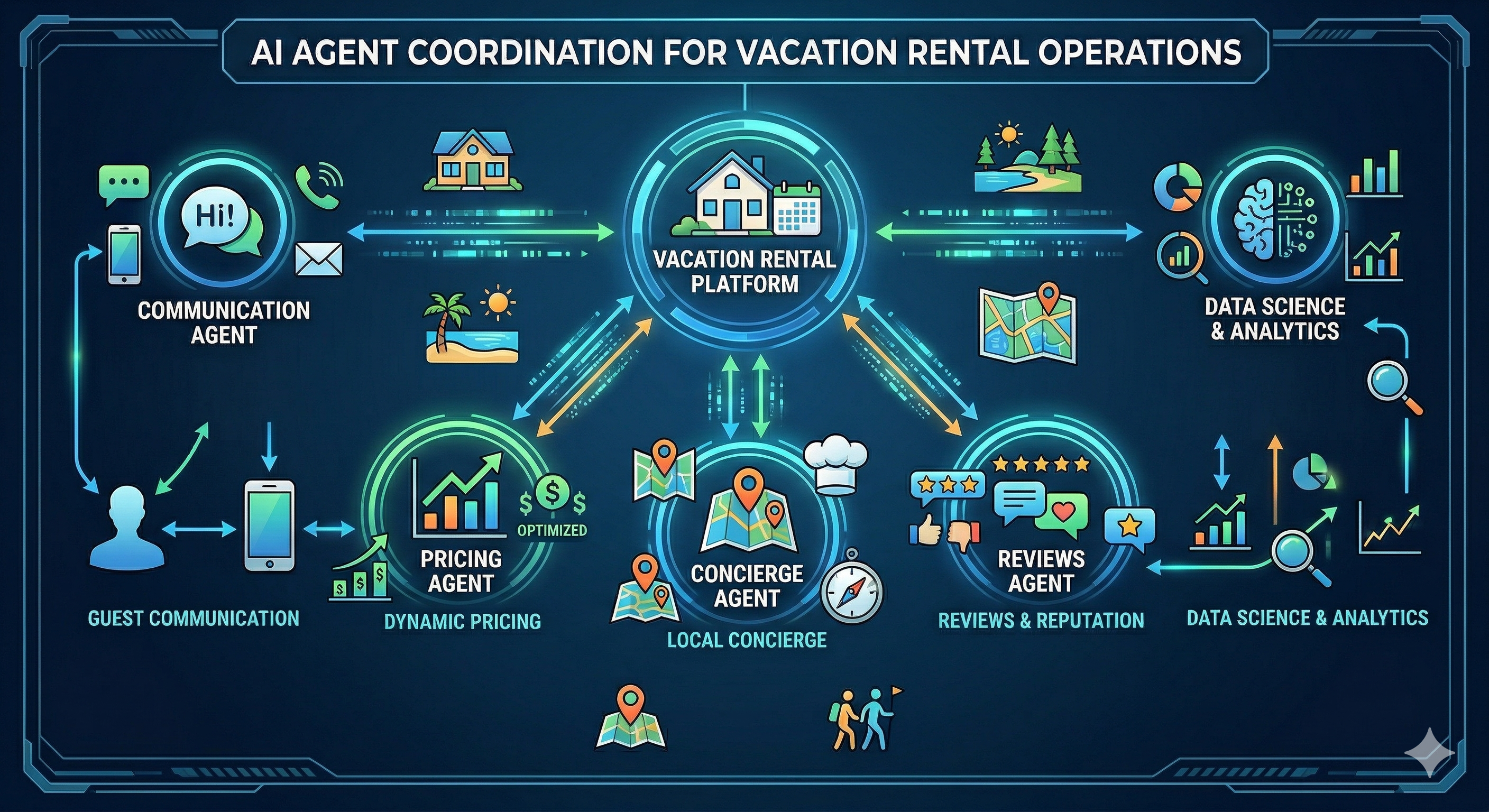
TL;DR: NIA is Jurny’s multi-agent AI system where specialized agents (Communication, Pricing Intelligence, Concierge & Upsells, Review Management, Data Science) work together to handle property management autonomously. Each agent is optimized for its specific function, sharing context and data seamlessly.
Why Architecture Matters (More Than You Think)
Let’s start with a simple analogy. Imagine you hire one person to run your entire property management operation: handle all guest communication, adjust your pricing, manage reviews, coordinate cleanings, suggest local experiences, and monitor equipment health.
This person is decent at some things. They’ll probably handle communication okay—answer messages, respond to basic questions. But they’re not a pricing expert, so your rates aren’t optimized. They’re not a hospitality specialist, so upsell opportunities get missed. They’re not an expert in equipment maintenance, so issues don’t get caught proactively.
They’re a generalist trying to be a specialist across seven different functions. The result? Average performance across the board.
Now imagine hiring seven people, each expert in their specific domain:
- A customer service specialist (communication)
- A revenue management expert (pricing)
- A hospitality concierge (experiences and upsells)
- A review management specialist (online reputation)
- A facilities expert (operations and maintenance)
- A data analyst (insights and pattern recognition)
- A coordinator (orchestrating everything)
Each person is optimized for their function. They share information with each other. Together, they’re vastly more effective than one generalist.
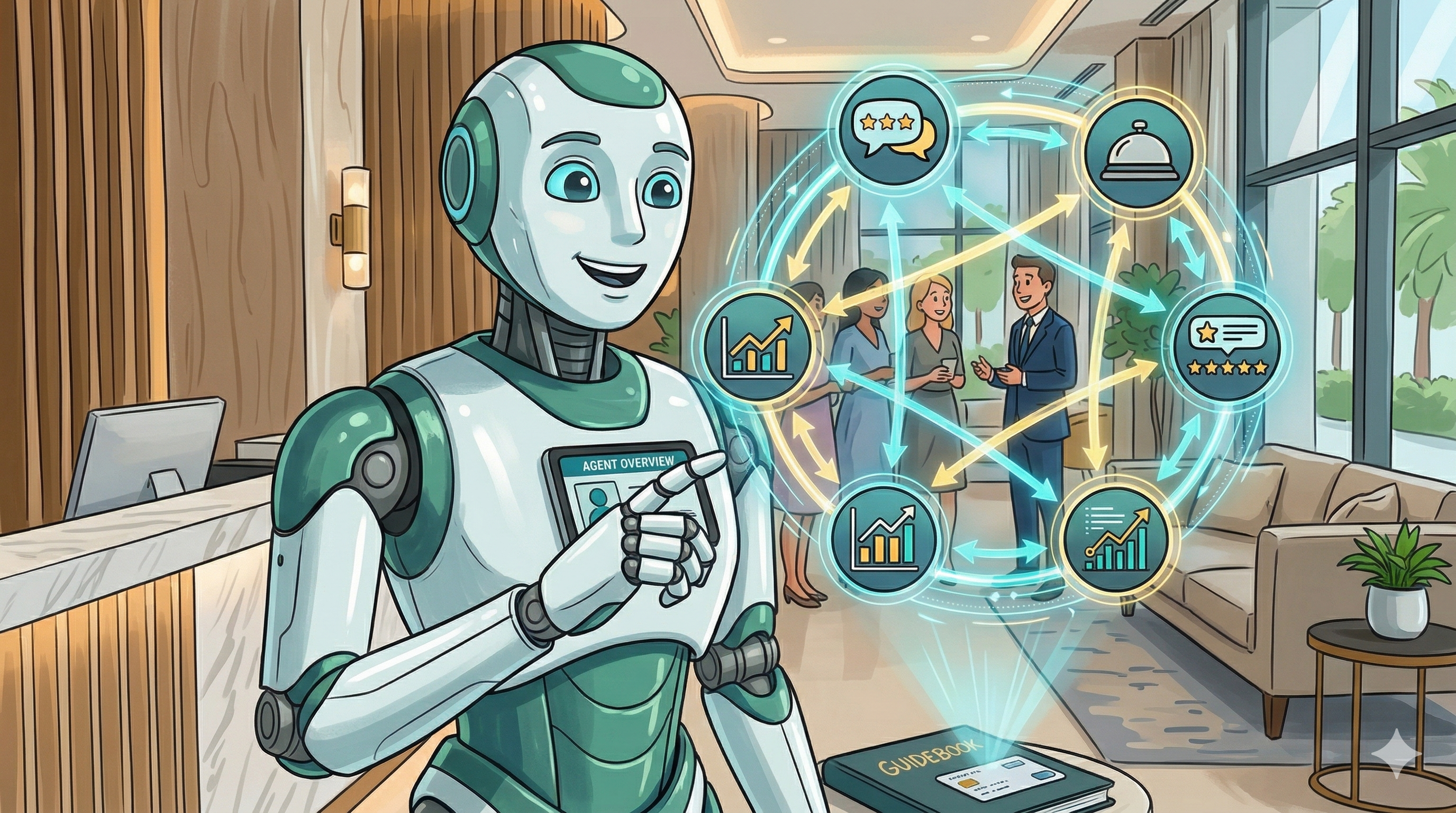
This is the distinction between single-bot AI systems and multi-agent systems like NIA.
Inside NIA: The Five Core Agents
Jurny’s NIA system consists of five specialized agents plus a coordinating layer that ensures they work together seamlessly.
Agent 1: Guest Communication Agent
What it does: Handles all guest messaging across all platforms (Airbnb, Vrbo, Booking.com, WhatsApp, SMS, email, direct bookings).
Specialization: Trained on thousands of property-specific conversations and guest interaction patterns. It understands:
- Your property’s specific amenities, policies, and procedures
- Seasonal patterns and local knowledge (restaurants, attractions, hiking trails, etc.)
- Your brand voice and communication style
- Common questions and optimal responses
- Escalation triggers (complaints, disputes, sensitive issues)
Autonomy rate: 80–90% of all guest messages are answered fully autonomously without human involvement. The remaining 10–20% (complaints, complex requests, edge cases) escalate immediately to you.
What this means in practice: A guest asks “What’s the Wi-Fi password?” Response time: 47 seconds. Guest asks “Can we check in early tomorrow at 1 p.m.?” Response: 62 seconds with availability check and upsell offer for early check-in. Guest complains “The neighborhood is too noisy.” Escalation to you: immediate, with sentiment analysis and guest history context.
The advantage over single-bot systems: Generalist bots can answer factual questions but miss contextual opportunities, personalization, and nuance. The Communication Agent is specifically trained on hospitality dynamics and learns constantly from your actual conversations.
Agent 2: Pricing Intelligence Agent
What it does: Optimizes your rates in real-time across all platforms using dynamic pricing algorithms.
Specialization: Analyzes:
- Real-time demand signals from all OTAs simultaneously
- Competitor pricing (updated hourly)
- Local events that drive demand (conferences, concerts, sports events, holidays)
- Seasonality patterns and booking velocity
- Your historical booking data and occupancy patterns
- Day-of-week and length-of-stay premiums
- Weather patterns (if applicable for your market)
Autonomy rate: 95%+ of pricing decisions are made automatically. You set strategic boundaries (min/max rates, seasonal strategy), and the agent optimizes within those parameters. Strategic adjustments you make quarterly instead of weekly.
What this means in practice: Your property might have different rates on:
- Monday: $120
- Thursday: $155
- Friday-Saturday: $210
- Sunday: $165
These rates adjust dynamically based on current demand. During the week of a major conference in your area, rates lift 40%. When occupancy drops below 60%, rates decline slightly to attract bookings. The agent balances occupancy (getting bookings) with rate (maximizing revenue per booking).
The advantage over single-bot or static pricing: Manual pricing happens weekly at best. Competitor pricing changes daily. Demand signals shift hourly. A generalist bot can’t track all these variables simultaneously. The Pricing Intelligence Agent monitors everything continuously and adjusts accordingly, capturing revenue opportunities that manual systems miss.
Result: 15–30% revenue increase vs. manual pricing. For a $3,000/month property, that’s $450–900 additional monthly revenue.
Agent 3: Concierge & Upsell Agent
What it does: Identifies revenue opportunities and proactively suggests upsells to guests while providing hospitality recommendations.
Specialization: Trained on:
- Guest profile data (demographics, previous stays, preferences)
- Booking patterns and purpose (family, romantic getaway, business, etc.)
- Your property’s amenities and local experience network
- Upsell packages (early check-in, late checkout, amenity add-ons, local experiences)
- Booking-to-guest-arrival optimal timing for upsell offers
Autonomy rate: 100% operational. The agent runs completely autonomously, suggesting upsells at optimal moments and managing booking with experience partners.
What this means in practice: Guest books a beachfront property for 4 nights. Concierge Agent analyzes: couple, summer booking, romantic context. It proactively suggests: late checkout ($50 add-on), beach picnic package through local vendor ($75, 15% commission to property), couples massage package through partner spa ($120, 10% commission).
Guest accepts two of three. Property captures $145 additional revenue on a $1,200 booking. Multiply across 20 bookings/month at $40–60 average upsell value per booking, and this agent generates $8,000–12,000 monthly ancillary revenue.
The advantage over manual or basic upselling: Manual upselling gets deprioritized in favor of operational work. You might mention amenities in a welcome email but rarely suggest contextual experiences. The Concierge Agent never forgets, never gets tired, and optimizes for guest preferences simultaneously.
Result: 30%+ additional revenue per booking through strategic upsells.
Agent 4: Review Management Agent
What it does: Responds to every review on every OTA simultaneously with personalized, sentiment-aware responses.
Specialization: Trained on:
- Sentiment analysis (distinguishing between positive/neutral/negative reviews)
- Your brand voice and communication standards
- Property-specific issues (common complaints, strengths)
- OTA-specific response guidelines and visibility mechanics
- Response timing optimization (responds within hours, not days/weeks)
Autonomy rate: 100% for reviews. Every review receives a response unless flagged by you as requiring personal attention (rare).
What this means in practice: Guest leaves a 5-star review: “Beautiful beachfront property, amazing sunsets, hosts were so responsive!” Response: “Thank you so much for the kind words! We loved hosting your family. Please come back and enjoy more sunsets with us!”
Guest leaves a 3-star review: “Property was decent but had noise from the street and the AC wasn’t cooling well.” Response: “We appreciate your feedback. We’re sorry you experienced noise and climate control issues. We’ve installed soundproofing on the street-facing wall and serviced the AC unit. We’d love the opportunity to host you again and show you the improvements.”
The advantage over manual review management: You probably don’t respond to reviews consistently. If you do, responses go out days or weeks later. By then, the damage is done—future guests read unresponded reviews and assume you don’t care. The Review Management Agent responds within hours, demonstrating responsiveness and commitment to guest satisfaction.
Result: Higher booking rates (responsive properties book faster), better reputation across platforms, and early warning system for operational issues (noise complaints trigger soundproofing solution; AC complaints trigger maintenance).
Agent 5: Data Scientist Agent
What it does: Analyzes patterns across all your data (communication, pricing, operations, reviews) and generates insights to inform decisions.
Specialization: Trained on:
- Booking pattern analysis (which guest types convert best, which marketing channels work best)
- Review sentiment trends (are certain complaints recurring? which amenities are consistently praised?)
- Revenue analysis (which guest demographics generate highest revenue per booking?)
- Operational pattern recognition (which guests are high-maintenance? which generate highest satisfaction?)
- Predictive analytics (forecasting occupancy, demand peaks, seasonal patterns)
Autonomy rate: 0% (Data Scientist Agent generates insights for you to act on). You review patterns weekly or monthly and make strategic decisions.
What this means in practice: You receive a weekly report: “Your weekend occupancy increased 15% in March. Review sentiment on ‘location’ increased from 4.2 to 4.6 stars. Family bookings (2+ guests) have 40% higher satisfaction scores than solo travelers. Recommended action: market to families and focus on family-friendly amenities.”
You receive a monthly report: “Noise complaints are trending up (3 complaints in past 30 days). All from street-side room. Recommended actions: (1) relocate that room to a less desirable rate category, (2) add soundproofing investment, or (3) relocate bookings away from that room.”
The advantage over manual analysis: You can’t read 100 messages/month and spot patterns. You can’t track review sentiments across 6 platforms and identify trends. Manual analysis is sporadic and biased. The Data Scientist Agent identifies patterns continuously and surfaces them systematically.
Result: Strategic insights inform better decisions on pricing positioning, guest targeting, operational improvements, and marketing focus.
How the Agents Work Together: The Coordination Layer
Having five specialized agents is only valuable if they work together seamlessly. This is where the coordinating layer matters.
When a guest inquires about early check-in, here’s what happens behind the scenes:
- Communication Agent receives the message and identifies it as an upsell opportunity
- Pricing Intelligence Agent is queried: “What’s the optimal early check-in premium for this date and guest type?”
- Concierge Agent is queried: “What additional experiences might this guest be interested in?” (combining early check-in with a restaurant reservation, for example)
- Data Scientist Agent is referenced: “What’s the historical acceptance rate for early check-in at this price point for this guest demographic?”
- Communication Agent generates a response: “We’d love to accommodate early check-in! We can do 1 p.m. for $75 additional. While you’re settling in, would you like us to book you a reservation at the beachfront restaurant next door?”
All of this happens in 30–60 seconds. Agents share context, coordinate recommendations, and generate a response that’s personalized, optimized for revenue, and guest-appropriate.
A single-bot system can’t do this. It can’t hold five different specialized functions and coordinate them simultaneously. The result is lower personalization, missed revenue opportunities, and slower response times.
NIA 3.0: What Makes the Latest Version Materially Better
Jurny released NIA 3.0 in 2026. The improvements aren’t marginal.
Accuracy improvement: NIA 3.0 is up to 300% more accurate than earlier versions in understanding context, intent, and nuance. This translates to fewer escalations, better guest satisfaction, and higher upsell conversion.
Hyper-personalization: Each agent understands guest and property-specific context at a much deeper level. Responses feel less templated. Pricing is more granular. Upsells are more contextually appropriate.
Cross-agent coordination: Agent handoffs are seamless. When one agent needs information from another, the request happens in milliseconds. Coordination that previously took manual steps now happens autonomously.
Real-time adaptability: Agents learn and adapt in real-time to your feedback. If you override an AI decision, the agent learns from that override. If you accept a suggestion, the agent learns to make similar suggestions in similar contexts.
Result: Properties using NIA 3.0 report 15–30% higher automation rates (fewer escalations), 20% higher guest satisfaction improvement, and 25%+ higher upsell conversion vs. earlier NIA versions.
Why Multi-Agent Architecture Beats Single-Bot
This comes down to specialization vs. generalization.
A single bot is a generalist. It tries to handle communication, pricing, operations, and upsells using one neural network architecture. This works okay for routine tasks but fails on nuance.
NIA is a specialist team. Each agent is trained specifically on its function using specialized data and optimized for its use case. A communication specialist trains on thousands of guest interactions. A pricing specialist trains on demand data, competitor analysis, and revenue optimization. A concierge specialist trains on guest preferences and experience matching.
Specialization always outperforms generalization when the tasks are diverse. You wouldn’t hire a single accountant who’s also a marketing director who’s also an engineer. You’d hire specialists. NIA operates on the same principle.
The Integration Reality: It All Connects to Your Ecosystem
NIA doesn’t exist in isolation. It integrates with:
- All 90+ OTAs (Airbnb, Vrbo, Booking.com, Agoda, HomeAway, etc.)
- Smart devices (locks, thermostats, noise monitors, appliances)
- Calendar and booking systems
- Payment processors
- Experience platforms (for concierge booking)
- Communication channels (WhatsApp, SMS, email)
This integration is what makes the agents effective. They need to see the full guest journey, access real-time data across platforms, and coordinate operational decisions. Without deep integration, they’re limited.
Frequently Asked Questions
Q: Is NIA removing human judgment from property management? No. NIA handles predictable, routine decisions autonomously. Edge cases, disputes, and judgment calls escalate to you. You remain the strategist; NIA handles the tactical workflow.
Q: How long does NIA take to “learn” my property and communication style? Initial training is 2–4 weeks. You provide past messages, policies, amenity information, and examples of communication you like. After that, the agents learn continuously from ongoing interactions. Adaptation is never-ending but requires minimal input from you.
Q: What if NIA makes mistakes? Can I override it? Yes. Every AI-generated response and decision is reviewable. If you disagree with a response, you can override it. The agent learns from your override. Error rates decrease over time as the system learns your preferences.
Q: Can NIA handle my unique property or unusual situation? Most properties are unique in surface details but similar in operational patterns. A beachfront villa is different from a ski chalet, but both need guest communication, dynamic pricing, and review management. NIA handles the patterns and adapts to property-specific details through training.
Q: Is there a risk of guests realizing they’re talking to AI and being unhappy? Modern AI responses are indistinguishable from human responses for most guests. By the time a guest realizes they’re talking to AI, they’ve already had their question answered in 30–60 seconds. Guests care about getting answered, not about who (or what) answered them.
Q: How does NIA handle emergencies or critical issues? Critical escalations (safety issues, guest distress) are routed to you immediately with full context. The Communication Agent recognizes severity and routes accordingly. You maintain final authority over critical decisions.
Moving Forward: Understanding the Difference
The key takeaway isn’t technical. It’s practical: Multi-agent AI systems outperform single-bot systems because specialization drives excellence.
NIA is Jurny’s implementation of this principle. Each agent is optimized for its function, trained on specialized data, and coordinated seamlessly. The result is automation that actually works—high autonomy rates, strong revenue impact, and improved guest satisfaction.
If you’re evaluating property management automation, ask about architecture. Single-bot systems are simpler but weaker. Multi-agent systems are more sophisticated but stronger. The difference shows up in real results.
Book a demo to see NIA in action across your property.
Explore Jurny: